


Information sent by the Australasian Waders Study Group
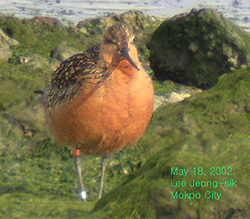
Photo © Lee Jeong-sik
Breeding in Siberia, staging on migration in South Korea, and spending the boreal winter in New Zealand and Australia, ca 12 000 Bar-tailed Godwit have been counted at peak in the Saemangeum area, along with internationally important concentrations of 17 other shorebird species (Barter 2002; NM pers obs). Especially considering the near daily turnover of migrant birds, with flocks arriving and departing throughout spring and autumn, a significant percentage of the flyway’s (and therefore New Zealand’s) Bar-tailed Godwits have been proved to depend on Saemangeum’s free-flowing estuaries.
Saemangeum: clearly an international issue.
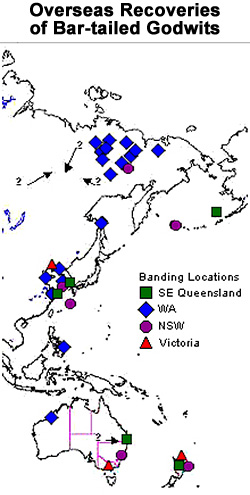
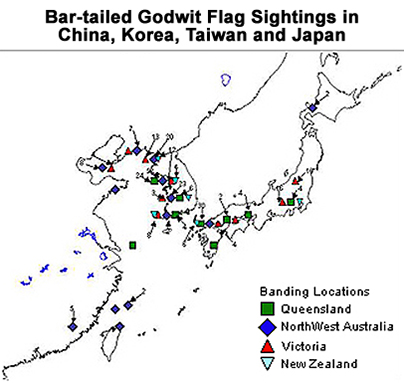
Overseas Sightings
Column 1 = Flagging Location, Columns 2 - 8 = Sighting Location
| HK | Taiwan | China | Japan | Korea | Russia | USA | NZ | TOTAL | |
| VIC | 0 | 0 | 18 | 37 | 23 | 0 | 33 | 121 | 232 |
| QLD | 0 | 0 | 1 | 40 | 34 | 0 | 15 | 45 | 135 |
| NWA | 5 | 7 | 36 | 3 | 77 | 3 | 0 | 19 | 150 |
| NZ | 0 | 0 | 12 | 7 | 8 | 0 | 15 | 2 | 44 |
| Total | 5 | 7 | 67 | 87 | 142 | 3 | 63 | 187 | 56 |

Additionally, Dr Phil Battley has provided the following information on the movements of migratory shorebirds through Saemangeum/Yellow Sea to New Zealand.
Migration strategies of shorebirds, and links with New Zealand
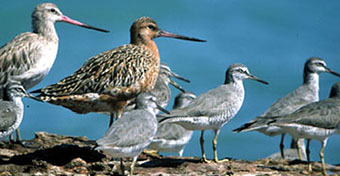
During the non-breeding season, New Zealand hosts in excess of 150 000 Arctic-breeding shorebirds, primarily Bar-tailed Godwits (c. 100 000) and Red Knots (c. 60 000). As subadult birds do not breed, the populations migrating north are estimated at 85 000 godwits and 50 000 knots. These species are classic ’long-haul’ migrants, migrating in only a few, extremely long flights. Predicted flight ranges of Bar-tailed Godwits from New Zealand are around 7 500 - 9 000 km (P.F.B. unpubl. data). This indicates that godwits may use only a single stopover in South-East Asia (currently unknown) or migrate direct to South Korea and Japan. Red Knots may stopover in northern Australia before a second flight to the Yellow Sea. Both species leave New Zealand from the 2nd week of March to the 1st week of April. During long flights birds use deposited fat as their primary fuel, but are unable to avoid breaking down lean tissue from muscles and organs. They will arrive physically depleted, with small digestive organs that may reduce immediate fuelling ability.
Links between New Zealand and South Korea are known from Godwits leg-flagged with a white plastic tag in New Zealand. Ten birds marked in New Zealand have been seen in South Korea on migration, including one at Saemangeum. Little intensive surveying has been done for leg-flagged godwits in South Korea; the majority of New Zealand-wintering godwits probably uses the South Korean tidal flats on migration.