


and prey availability in Delaware Bay, USA, Spring 2004
Report No 1, May 14th 2004
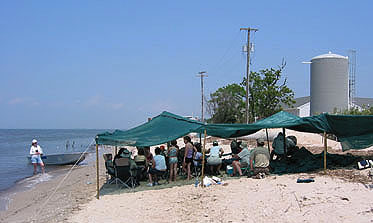
"It is with great pleasure that we report good news from Delaware Bay for a change. We have now been here five days and everything we have seen has been most heartening…
Firstly the Horseshoe Crabs (Limulus polyphemus): for the first season ever there is a complete and effective moratorium on the harvesting of Horseshoe Crabs by any method. This continues until June 7th, by which time all the northward migrating waders should have departed.
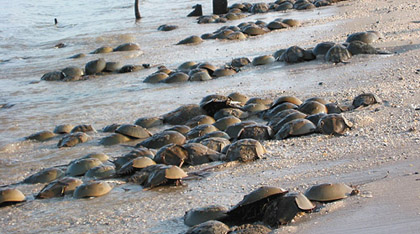
The absence of harvesting (actually for the second year on the New Jersey side of the bay) plus a sustained period of calm, dry, hot, sunny weather and the fortuitous timing of a full moon on May 5th has resulted in the best and most continuing spawning by Horseshoe Crabs that I have seen in the eight years I have been coming here.
This is taking place on almost all the beaches around the Bay and is resulting in huge numbers of successfully laid eggs buried in the sand and large quantities spilt on the surface. For the first time for three years we saw a green carpet of eggs on the sand metres wide and tens of metres long at one location yesterday. We are in the unusual situation of having heaps of food available for the birds - more than the current wader population can consume. Huge quantities of eggs are, as usual, also consumed by the hordes of Laughing Gulls Larus atricilla.
Those shorebirds which have arrived have got here in excellent condition - possibly better than in any previous year since we started studies in 1997. This is because for the last week there has been such a benign weather situation stretching all along the Atlantic coast of the U.S. right down to the Carribean.
Whilst numbers of most species have been doubling from one day to the next we are slightly surprised that we have probably only got 20% of the total expected numbers of birds here so far.
Yesterday’s estimate was about 8,000 Sanderling Calidris alba and 3,000 Ruddy Turnstone Arenaria interpres on our (New Jersey) side of the bay with around 4,000 Red Knot Calidris canutus overall on both sides of the bay (c. 3,000 in N.J. and 800+ in Delaware).
We are expecting/hoping for an avalanche of new birds in the next few days and we are praying that the excellent conditions for migration persist long enough for this to happen.
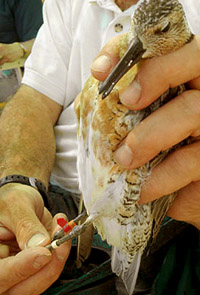
Our catching and banding programme is continuing very much as planned. The objective is to catch 50 - 80 of each of the three main study species (Red Knot, Ruddy Turnstoneand Sanderling) every three to four days throughout the 20 - 25 day period the birds are present here…
We caught 63 Ruddy Turnstone, 67 Sanderling and three Red Knot at Reeds Beach on May 11th.
We then had 61 Red Knot at Fortescue on May 13th, including two with Argentinian bands on. One of these had a unique band combination and had been seen many times in Argentina, including as recently as April 6th.
Today we returned to Sanderling and Ruddy Turnstone, banding 95 of the former and 51 of the latter (plus three more Red Knot).
In all species the weights of most birds were excellent. There was a complete absence of low weight birds in all three species. We attribute this to the excellent migration conditions. Frequently in the past a significant component of newly arrived birds have been up to 20% below their fat-free weight.
The average weight of the May 13th Red Knot catch was 131g (range 100 - 169g) which is the highest mean weight for Red Knot in the first half of May in any of the eight years of the study.
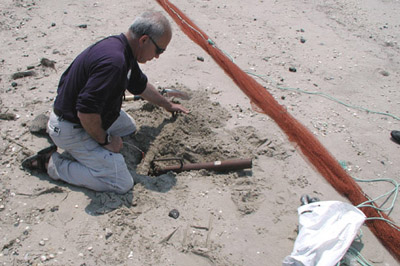
laying a cannon net.
Sixteen radio transmitters have now been put on Red Knot and a complete aerial survey tracking them is carried out every day. There are also 18 automatic radio-tracking stations, operating 24 hours a day, spread around the bay and all these should be tracking birds effectively from this evening onwards. Already they are showing just how incredibly mobile Red Knot are after arrival on the Bay - even in this year’s good feeding situation. Two individuals have already been located in three widely different places including one location on the Delaware side of the bay.
So the present mood is one of considerable optimism for the long-awaited turnaround in the fortunes of the waders using Delaware Bay as their last, critical, stopover location en route to their breeding locations in the Canadian Arctic…
But we are well aware that the situation can change dramatically in adverse weather conditions either here or on the migration route further to the south. We continue to keep our fingers crossed that the excellent start to the season is sustained and that this year the majority of birds are able to depart at the end of May on time and in the optimum condition with fat accumulations sufficient for their 3 - 4,000km journey and a reserve to tide them over the potential food shortages/high energy demands in their first few days on the tundra.
Report No 2, May 23rd 2004
The news from Delaware Bay continues to be pretty good, but with one caveat…
The weather has continued hot and calm and the Horseshoe Crabs have been spawning daily on both tides - massively so on the high tides at night over the last few days associated with the new moon of May 19th.
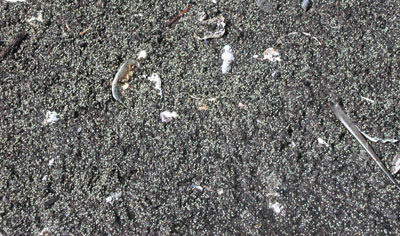
Eggs are plentiful on all shores around the bay, with green carpets of spilled eggs in patches as large as a tennis court on some beaches. At Mispillion Harbor on the Delaware side of the bay there was a tide wrack 3" deep in eggs one day. Thus all the shorebirds which have reached Delaware Bay have had heaps of good food to fatten up on.
The net result is that the mean weights of our catches of Sanderling, Ruddy Turnstone and Red Knot have mostly continued to be at the upper end of the range for the corresponding dates for the previous 7 years, and in some cases average weights were at record levels.
In catches on the 18th and 20th of May we thus had Red Knot weighing up to 190 grams, and Sanderling up to 99 grams ie. these birds had reached their take off weight some 10 days before they need to depart.
So far so good BUT…
…What had surprised and worried us is that during the aerial survey of the complete bay on Tuesday (18th) only about 40% of the minimum expected number of birds of each species were present.
With only 10 days to go before their average departure date they seem to be leaving it awfully late in arriving here. Given that the weather conditions right down to the Caribbean seem to have been consistently suitable for migration this lack of arrivals is puzzling.
HOWEVER…there were good new arrivals yesterday and an avalanche of new birds today (21st May).
A count just of the 10 miles of beach here and to the south revealed 31,000 birds on this morning’s high tide where there had only been about 10,000 three days ago. So maybe they just got here in time. With all the food available, and reasonably light wind conditions forecast for the next few days, they will hopefully be able to get enough food to double their weight over the next ten days.
To indicate what is achievable in good feeding conditions we recaptured a Sanderling yesterday weighing 82 grams which we had been banded only 6 days previously at 57 grams. This is a rate of weight gain of 4 grams per day or about 8% per day based on it’s fat free weight. To put it in human terms, it is like an 80Kg person being 86 Kg the next day, 92 Kg the following day etc. and 140 Kg at the end of 10 days!!
We are spending a lot of time scanning flocks for the lettered/numbered leg flags which identify individual birds. This is proving most successful and will this year (on Red Knot) and in future years (on all species) give reliable survival rate measurements.
We’re also seeing quite a lot of individual birds marked with these engraved flags in Argentina and Chile and even one from the Arctic breeding grounds.
Some members of the team are entirely allocated to this extremely valuable scanning process.
So we are still in a most hopeful mood that this year is going to see the Delaware Bay situation turn the corner and that birds are going to get away on time and in such condition that they have a successful breeding season inthe Arctic (to start making up for recent poor breeding seasons and the disastrous situation in 2003)…
Report No 3, May 27th 2004
Our fears have been proved to be well founded…
Yesterday’s aerial count revealed just 13,500 Red Knot on the whole of Delaware Bay. This is down from 16,000 last year.
Ruddy Turnstone and Sanderling numbers were also lower than normal.
Yesterday should have been the peak population count. All birds should now have arrived and as far as we can tell none had departed by the time of the late afternoon count.
The Red Knot numbers continue the steady decline from 100,000+ in the 1980’s to around 60,000 in 1997, through 30,000 three years ago, to last year’s previous lowest level ever.
It is not altogether surprising that the decline here is continuing because it is only this year, for the first time in eight years, that there have been satisfactory feeding conditions for Delaware Bay migrants. If, as hoped, this results in improved breeding success in the Arctic this year it will still be 2006 before such better productivity carries through to the migratory population, Red Knot only breeding for the first time at age two.
What is baffling is that the count of Red Knot in Tierra del Fuego (Chile and Argentina) in Jan/Feb in each of the last two years has been close to 30,000 birds.
Where were the rest last May and this year?
Have they gone elsewhere to re-fuel?
Have they not migrated due to perceived difficulties in fattening at Delaware Bay experienced in recent years?
Or is there some other factor operating in the Flyway which we don’t know about?
An urgent repeat request has gone out today to every shorebird person and state wildlife body on the eastern shores of the United States from Florida to Massachussetts asking them for any recent observations of Red Knot and requesting them to check out all possible areas over the next couple of days.
For the birds which have reached Delaware Bay successfully, this year continues to be a bonanza. The weather continues to be settled and the Horseshoe Crabs continue to spawn.
For example at Fortescue, where we were catching yesterday, there was again a green carpet of eggs on the shore as the tide went out. Birds were so able to gorge themselves that a significant proportion of the population was roosting rather than feeding, presumably because they needed a period of digestion after such a rapid intake of food.
Our catching programme continues to go unbelievably well.
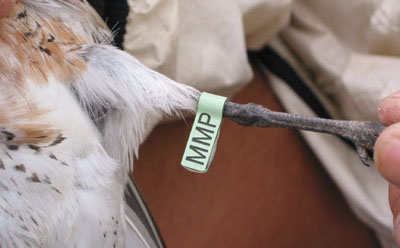
Our target was to catch 500 new Red Knot and 500 Ruddy Turnstone on each side of the Bay (ie. New Jersey and Delaware) and 1000 Sanderling (all in N.J. because there are only a few in Del.).
One objective was to get this number of new birds with individually-marked leg flags (three letters on a flag) for survival rate measurements derived from sightings of these birds in subsequent years. The second objective was to space out these catches equally during the three to four week period which the main populations of these three species are present on Delaware Bay. This would enable us to detect new arrivals (through low weights), measure arrival condition (ie. weights), measure the rate of weight gain of the population as a whole and of individuals or cohorts within it, and to determine weights reached at departure and the proportion of the population that fails to reach the departure weight by the normal departure time.
We were thus aiming for six to eight catches of 50-100 Red Knot and Ruddy Turnstone and a similar number of catches of 100-200 Sanderling.
We have amazingly achieved almost exactly this so far with a mixture of single species, two species and even three species catches.
With probably two potential catches to go on each species over the remaining four or five days which they are likely to be here we have had:
381 new Red Knot (plus 51 re-traps)
419 new Ruddy Turnstone (plus 56 re-traps)
and 811 new Sanderling (plus 50 re-traps).
Almost all the re-traps were from previous years, but we have had a few within-year re-traps, some showing some excellent weight gains of up to 8% per day.
With continued calm weather forecast we are hopeful that a high proportion of the birds here will get away this year on time and with all the fat reserves they need for their journey to the Arctic and for their initial needs up there.
There is of course a lot of other work going on around the Bay. 66 radio transmitters are now attached to Red Knots to track their movements within Delaware Bay and to determine their departure dates. This is done via three methods:
There are 18 fully automatic radio-tracking stations placed around the Bay and recording information 24 hours-a-day.
A plane does a three and a half hour flight each day around the Bay and over the adjacent Atlantic Coast marshes with two recorders in the plane and radio-tracking aerials attached to its wings.
There are individuals with hand-held tracking equipment visiting prime Knot sites by land or boat.
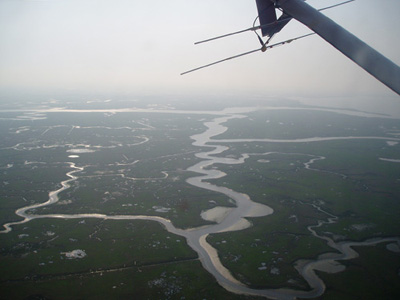
Delaware Bay. The aerial used for radio tracking can be seen attached
to the wing of the plane.
Generally they are picking up about 90% of the transmitters each day, but this will decrease from today onwards as birds depart (there is some evidence that departures of Knot and the other two species did in fact commence on a small scale last night).
We are taking a couple of breast feathers (for sex-determination) and a primary wing covert (for stable isotope analysis) from each Knot caught.
The results of this work won’t be known for a little while of course.
There is also regular monitoring in progress by a number of methods of the number of Horseshoe Crabs spawning, the numbers of eggs they have left successfully buried in the sand, and the number of spilt eggs available to the shorebirds and gulls.
There is also exclosure experiments in progress to determine the proportion of eggs taken by the shorebirds and gulls.
Report No 4, June 5th 2004 - Final Report Delaware Bay
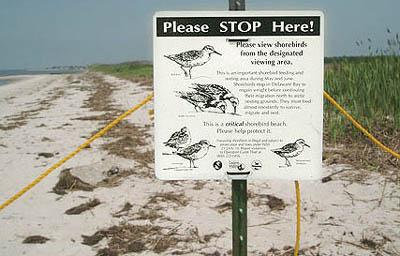
In the last week or so the weather has reverted to the more normal, changeable spring weather after nearly three weeks of settled weather. We can at last report (June 4th) that the beaches are almost bare of shorebirds. Last night, in the first settled weather conditions for almost a week, there were massive departures of most of the remaining birds. We are now packing up and leave for home tomorrow.
The major initial departures of Red Knot, Ruddy Turnstone and Sanderling which took place between the 25th and 28th of May were brought to a halt and only occasional, small departures took place over the next week because of wet or windy conditions or thunderstorm activity in the late afternoon/early evening creating unsuitable weather conditions for migration.
We have been able to regularly count the birds and also monitor their weights up until Wednesday (June 2nd) when we finally ran out of "quota" on all three species.
The most interesting feature is that small numbers of Red Knot appear to have continued to arrive on both sides of Delaware Bay until a couple of days ago.
This was apparent because of
the appearance of previously unseen individually-flagged birds from 2003
the appearance of birds with generally lesser amounts of breeding plumage (including a few juvenile/first-year birds) and low-weight profiles
and catch samples containing low-weight birds.
It is unclear whether these birds had been making their way up the east coast of the USA from staging areas further south or whether they had come in from further afield. There is also a suggestion that they are a less heathly part of the population with feather lice present on most birds caught.
Overall the main conclusions from this year’s work are:
Most Sanderling and Ruddy Turnstone which reached Delaware Bay found plentiful food and gained weight rapidly such that almost all individuals were able to depart in excellent condition and on time.
Surprisingly more Sanderling went before Ruddy Turnstone this year whereas in previous years Sanderling were usually the last species to depart;
The cohorts of Red Knot which arrived on Delaware Bay in the second and third weeks of May prospered and also gained weight very rapidly and departed on time or even a little early. However arrivals continued much later than normal and many of these late arrivals have had considerably more difficulty in reaching satisfactory take-off weights;
Weights were vastly higher on all three species than in the disastrous 2003 year and that in many cases average weights on particular dates were higher than in any of the previous seven years. However for Red Knot weights went awry towards the end of the period and showed a markedly different pattern to the weight of the other two species;
The "quota" allocation of 500 new Red Knot, 500 new Ruddy Turnstoneand 1000 new Sanderling for New Jersey seems to have worked well. It was possible to space out catches such that adequate samples were obtained of each species at approximately three day intervals throughout the period which birds were on the Bay and therefore to track arrival weights, rates of weight gain and departure weights satisfactorily.
The only disadvantages were that we were not able to catch birds to measure the weights of the significant populations that were still present on June 3rd and that the lower overall catch totals resulted in less than 10 within-season re-traps (50+ in previous years).
One Knot this year had, incidentally, gained 56g in the five days between the 13th and 18th of May - a 10% addition per day!
On the New Jersey side of the bay our total catch was 517 new plus 66 re-trap Red Knot, 519 new plus 62 re-trap Ruddy Turnstoneand 1054 new plus 63 re-trap Sanderling.
On Tuesday we re-captured a Sanderling carrying a Paris band. It was marked in Surinam (French Guyana) in 1997;
The moratorium on Horseshoe Crab harvesting from May 1st to June 7th seems to have been very beneficial in allowing crabs to repeatedly return to the beaches to complete their full, normal spawning programme. The fine weather and advantageous timing of the full and new moon high tides has also been helpful in making more eggs available for the birds than in any recent year;
The daily monitoring of the 66 radio-transmitors applied to Red Knot has given some excellent results judging by the records from the daily aerial flight of the bay (the results of the automatic tracking stations will take longer to download and decipher).
The Knot proved to be extremely mobile within the bay with most individuals changing locations at some time and many crossing the Bay, in both directions, between New Jersey and Delaware.
Four birds located in Delaware one evening, were found night roosting in New Jersey after dark, but where back in Delaware again the next morning! They certainly seems to be a species that is prepared to regularly explore the Bay in the search for the optimum feeding conditions. Hopefully some of these transmitters will be located in Arctic when the expedition goes there on June 24th;
In spite of all the above encouraging information, the big negative of this year’s work is that the overall population of Red Knot (and Ruddy Turnstone and Sanderling) has, as predicted in two recent scientific papers, decreased still further.
This year’s maximum count of 13,500 is a far cry from the 100,00+ present 15 years ago.
Even if this does prove to be a good breeding year for Red Knots in the Arctic it will still be two years before this shows up in the migratory population - and coming from such a low population base now it will take many years of good breeding to re-build former population levels. Furthermore, with Horseshoe Crabs not breeding until they are ten-years-old it will take many years for the effects of the excessive harvesting which took place in the last decade to work its way out of the system.
Therefore a rapid turnaround in Red Knot and other shorebird populations cannot be expected. Nevertheless it is encouraging that the first fundamentals to a turnaround seem to have occurred. We just hope that the reported "two weeks later than normal" season in the Arctic doesn’t prejudice potentially good breeding performance this year."
Dr. Clive Minton, spring 2004
For more about the AWSG, go to Australasian Wader Study Group
In May 2004, Birds Korea posted a news report from the US directly relating to this story, which is reprinted below:
(MICHAEL GORMLEY, Associated Press Writer: ALBANY, N.Y.) States from Maryland to New York have joined in an uncommon effort to help a 5-ounce bird’s 8,000-mile migration across two continents.
Every spring, the Red Knot Calidris canutus travels from South America, feasting on horseshoe crab eggs in Chesapeake Bay before taking on the last leg of the route through New Jersey and New York into Canada. The plump bird that leaves winter homes as far south as Tierra del Fuego arrives on the East Coast sparrow-thin and needs the crab eggs to survive the rest of the trip.
But a decline in the population of horseshoe crabs - used mostly as commercial fishing bait - and in the thousands of eggs each bird needs to replenish itself has pushed the Knot closer to extinction. One New Jersey study found the population of the salmon-breasted bird reaching a healthy weight dropped seven fold from 1998 to 2002.
The total population is estimated at 70,000, down from 150,000 in the 1980s, according to the Audubon Society. Wildlife groups have predicted extinction within a decade.
Audubon and other environmental and wildlife groups worked with state officials from Maryland, Delaware, New Jersey and New York, to help the bird by limiting the horseshoe crab harvest. In March, the Atlantic States Marine Fisheries Commission adopted limits on how many horseshoe crabs could be taken beginning this spring.
"This is unprecedented and may even be unprecedented nationally," said Brad Spear of the 62-year-old federally funded consortium of states from Maine to Florida. "I’m not familiar with any other cases."
The decision "is critical in the future conservation of the Red Knot and the horseshoe crab," said David Miller, executive director of Audubon New York. The group "is very thankful for New York state’s commitment to restrict their landing quota of horseshoe crabs."
The states in the commission supported the lead of New Jersey and Delaware, which in recent years enacted limits. New Jersey and Delaware supported a more than 50 percent cut in the harvest, to 150,000 crabs a year for each state. Maryland, which several years ago had voluntarily limited its harvest to 211,000, agreed to an annual cap of 170,000 crabs, said Spear of the fisheries commission. New York voluntarily limited its harvest to 150,000 crabs this year, down from 360,000.
"That lent significant credibility to the action," Spear said.
The states overcame strong opposition by individual commercial fishing enterprises, who said the limits will create a ripple effect for the industry and consumers. Horseshoe crabs are used principally as bait to catch eel for lucrative foreign markets and conch. Some eel caught with the crabs are then used as bait to catch stripers, a high demand fish for restaurants.