


At present, most skylarks in north-east Asia are said to be Northern (or Eurasian) Skylarks Alauda arvensis ssp. Possibly three forms occur in Korea, ranging from the pale lonnbergi to birds with virtually all-dark tertials like pekinensis.
The most heated debate is saved, though, for the taxon that is the focus of this Identification Forum note - japonica, a form appearing to be somewhat intermediate between Northern and Oriental Skylark Alauda gulgula, so that is has been described variously as Alauda arvensis japonica, Alauda gulgula japonica or Alauda japonica. While it appears closer to Northern in general appearance, like Oriental it keeps its tail largely closed during song-flights.
Japonica has a range that extends from far eastern Russia (where it apparently breeds) south to China (where it is believed a winter visitor), east to Japan (where it is a summer visitor to Hokkaido while mostly resident in the south). In South Korea it appears to be widespread and resident in the south-east and a not uncommon migrant along the east coast and in the west (though perhaps outnumbered especially in the west in winter by Northern Skylark, which is also a local breeder).
Personal observations and fieldwork (alluded to in comments below) throughout its poorly-known range suggest that japonica might indeed merit full species - Japanese Skylark or Japanese Lark, although the picture remains confused by lack of information from areas of potential overlap between the various taxa. Though recognized as a full species by some authors now (e.g. Mackinnon and Phillipps, 2000), the identification criteria have generally been poorly presented. The aim of this note is therefore to present some suggested identification criteria (most of which are covered in detail in our video) and to elicit further responses from birders within and outside of the region. (It is encouraging to note that several birders in Korea are now separating japonica in the field: a development likely to lead to much greater understanding of its identification, distribution and status).
Description
The following description, based on 13 years personal observations in Japan and Korea, will undoubtedly evolve further but in general Japanese Lark:
appears rather smaller and squatter than Northern, with a shorter tail, a more pointed bill, and shorter crest.
appears more rufescent, with warmer ear coverts and uppertail coverts, and a striking rusty-rufous wing panel on the closed wing. The tertials - which are broadly fringed (and tipped paler in early spring) often have distinct rufous shafts.
invariably has a very well-defined warm buffish-orange pectoral band within which black streaking, usually forming neat lines right across the upper breast, is effectively confined - noticeably neater than the diffuse patterning common to most Northern, where the streaking is concentrated on the breast sides, often running untidily down the flanks.
tends to show a variably off-white or a dirty white trailing edge to the wing in flight, and perhaps less obvious white in the tail sides than typical in Northern.
often appears rather darker faced. Northerns nesting along the west coast of South Korea especially appear rather open-faced, with more obviously paler bills.
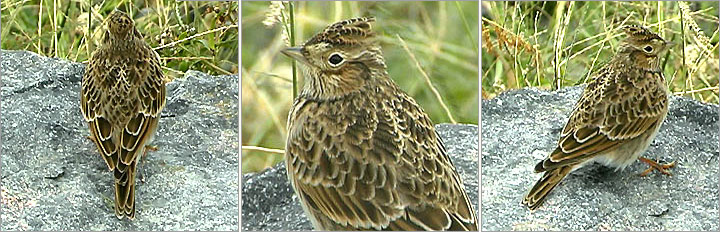
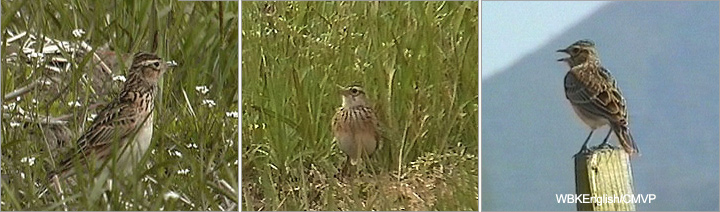
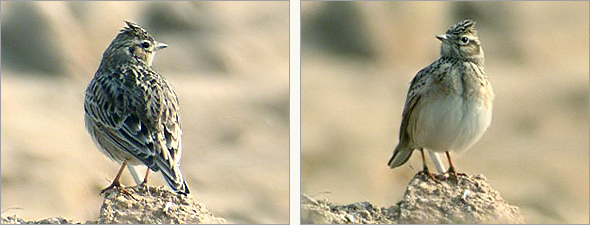
NB: these spring adults (Images 4 - 6) from Japan and this individual on Eocheong Island (Images 7, 8, taken in March 2003) show the breast band well, and also show the typically dark sides to the neck that highlight the cleaner, unmarked throat.
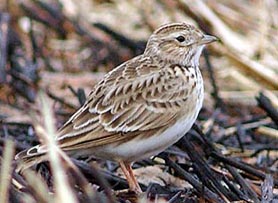
Photos © Kim Hyun-Tae.
Behavior
Japonica is generally rather more approachable and rather more tolerant of people than Northern Skylark. It occupies a wider range of grassy habitats, and while found mostly in rice-fields, it often also feeds on road verges, in longer grass, overgrown allotments and other edge habitats (including in Japan driveways and small gardens in suburban areas near more open areas: two pairs even used to nest in the central reservation of a busy expressway in Fukuoka in the early 1990s). When flushed japonica tend to fly shorter distances than Northern, landing with a sudden swerve, often into or behind thicker patches of vegetation, rather than parachuting or descending more hesitantly into the center of more open fields. For nesting, in South Korea at least, japonica occupies a wide range of grassy areas, most often in or near rice-fields, while Northern Skylark seems to prefer more sandy, drier and less disturbed areas: hillsides in arable areas, or on more open areas of reclaimed land, often near isolated patches of thicker vegetation. In territory, japonica regularly sings from the ground or low perch - while Northern appears to do so rather less commonly. The song is less varied and less melodic than Northern, which often adds a purer, descending note into the main song, and the call is drier.
Download a 29 second sample of the song of the Japanese Lark in Image 6:


NB: Separation from Oriental Skylark (a taxon not yet reliably claimed in Korea, though one possible individual was heard and seen in flight on Eocheong Island in 2002) might well prove more difficult. However, Oriental is believed to lack the obvious breast band, typically shows a very short primary projection, and has a distinctive rasping flight call.
Comments and discussion
Joseph Morlan, Californian Rare Birds Committee
Your treatment of japonica as a full species is interesting, but why not regard it as a race of A. gulgula with which it shares many morphological and behavioral traits? C.f. the treatment by Jurgen Haffer in the "Handbuch der Vogel Mitteleuropas" (U. Glutz, ed.). It is sympatric with arvensis on Kunashir Island and elsewhere, but I am unaware of any sympatry between japonica and gulgula during the breeding season.
Joseph Morlan, Pacifica, CA 94044: mailto:jmorlan@ccsf.org
Nial replies
Whether Japanese Lark belongs to the Oriental Skylark complex rather than Northern Skylark is something that I asked Krister Mild by mail several years ago, and have attempted to discuss with a fair number of very competent researchers and birders experienced in the region. It was an opinion I used then to hold too, largely contrary to the people I was talking with.
Japanese Lark is apparently somewhat intermediate between the two species, though considered rather closer in appearance to Northern, and it does appear to show some unique characters. Separation from Oriental Skylark in the field is based amongst other things on its rather more obvious whiteish/offwhite/buffy-white trailing edge to the secondaries; its typically rather longer primary projection (though … variation is apparently great); its overall structure, including longer tail (and overall measurements, I believe, unless you have access to better information? Interestingly, Robson 2000 gives length of Oriental up to 18 cm, while Brazil 1991 gives length of Northern Skylark as 17 cm); and its vocalisations, which for example lack the hard "bazz-bazz" believed typical of the species. All of these characters suggest a closer resemblance to Northern Skylark.
Differences from SE Asian Oriental Skylark depicted in Robson include most obviously that Japanese Larks show a clearly saturated breast, well demarcated from obviously whiter underparts, rather than the generally suffused underparts depicted. This is something I have never seen (yet) on Northern Sklark or seen in Oriental Skylark or its depictions, though it by itself can often be quite striking in Japanese Lark.
How reliable/comprehensive are Oriental illustrations though, or our knowledge of the forms of it?
Lacking experience in central Asian and most other forms of Oriental I want to add the response of Paul Holt (arguably one of the best field birders anywhere, with great experience of Orientals from much of …western, central and southern Asia) to Japanese Lark. [In Korea] last winter, when looking for 20-30 minutes at a flock of what I identified as Japanese Larks, he commented simply that he considered them to be Northerns… based, I believe, on calls, structure and plumage.
Problems with developing solid criteria are therefore very significant: who within the region is looking at them in detail? Few, if any people I know were/are interested in looking at the forms in any detail, and even Brazil 1991 does not mention reported sympatric breeding of japonica and ?lonnbergi on islands off Hokkaido. I believe I am alone in South Korea in trying to separate the forms in the field. The few specimens I looked at in two University collections were not labelled to subspecies.
Japanese birders/researchers (at least up to 5 years ago) used to consider all the "skylarks" in Japan to be part of the arvensis form, and separated them into three subspecies which in Japanese had only 2 common names: O-hibari, the Large Skylark, referring to presumably pekinensis and lonnbergi, and hibari, presumably referring to japonica alone. (I have, however, subsequently seen one published photograph of what is claimed to be Oriental in a recent Japanese photo guide, further confusing the issue).
As for the far east of mainland Asia, Dr. Pavel Tomkovich, one of Russia’s more respected taxonomists, informed me (pers comm) quite a few years ago that Japanese Larks also breed sympatrically with Northern Skylark in far eastern Russia, but I believe he did not have access to published material on the forms at that time. In China, Mackinnon and Phillipps 2000, state that Japanese can be told by its larger size than Oriental, but in contradiction give the length as 17cm for Japanese and 19cm for Oriental (and 18cm for Northern).
The situation continues to become even more confused in that looking at photographs taken of skins in the British museum (presumably the source of some of the references for measurements and criteria), at least one "japonica" appears to be labelled in Japanese as having been collected in Burma, far south of where that form is at present thought to occur.
You very reasonably ask about the lack of sympatry between breeding Oriental and Japanese Lark, which indeed might well be useful in understanding relationships, but I wonder, considerations of species concepts apart, if such sympatry occurs, who would actually notice it based on present information?
In summary… it would surely be very useful to try to look more closely at the larks in the region (as has been happening with gulls etc) to try to get a better understanding of relationships and criteria. From criteria developed personally in the field over the past 12 years within the region where the Japanese Lark occurs, [they] appear to show reasonably consistent characteristics, some of which are believed on present knowledge to be unique to it (such as the pectoral band), suggesting it might well merit specific status.
What I [have] found, and what you write now, simply reminds me that there is a lot of work still to be done to understand the relationships and identification criteria… DNA work would perhaps be most helpful.