


In terms of global biodiversity, South Korea has three major habitat types of extraordinary value. Most immediately threatened are the tidal-flats, which form the focus of much of Bird Korea's work; most designated (as National Park-land) are some of its mountain forests and streams; and most unusual is the thin sliver of land (and sea) that presently marks the line separating south from north - the de-militarized zone or DMZ. While South Korea is ablur with activity and change, within most of this narrow 4-km wide strip, time has largely stood still, for five long decades. Close to the DMZ, scarce summer summer visitors to the south, like Ruddy Kingfisher, Watercock and von Shrenck's Bitterns become more numerous (hinting at higher populations still within in its confines), while secure within, there must still be suitable habitat for the now extremely rare Tristram's (White-bellied) Woodpecker...A short article on the DMZ by Rick Ruffin (published in the Korea Times).
By Rick Ruffin
About 16,000 life species are now faced with extinction, according to the World Conservation Union (IUCN), a consortium of 110 governmental agencies, 800 non governmental agencies and some 10,000 scientists and experts worldwide.
Currently, extinctions are occurring at rates 1,000 times higher than at any other time in human history. Other mass extinctions occurred 205, 250, 375 and 440 million years ago, well before man arrived on Earth.
The difference between past extinctions and the ones happening now is very clear: 99 percent of species extinctions currently taking place are directly attributable to mankind.
Most recently, we lost the Yangtze river dolphin, also known as the baiji. Dams, pollution, boat propellers, fishing nets, dynamite and loss of habitat proved too much for this fresh water cetacean, which was officially listed extinct sometime in 2007.
Also in 2007 we lost the West African black rhinoceros, which was poached into extinction largely due to Asian demand for powdered rhino horn, an aphrodisiac, and Yemeni demand for dagger handles, carved from rhino horn.
According to Valmik Thapar, an Indian tiger expert, India's tigers will need ``a miracle'' to survive. With around 1,300 Indian tigers left, he foresees imminent extinction. Once again, poaching is to blame, namely Asian demand for tiger bones used in Oriental medicine.
The Indian government's latest policy of allowing multiple use of the remaining forest means increasing conflict as the growing human population comes into contact with the few remaining tigers.
From 1850 to 1950 more than 100,000 tigers were hunted and killed. Now, one percent of the giant cat's former numbers remain.
In Southeast Asia over 90 percent of the orangutan's habitat has been destroyed, mostly to support palm oil plantations in Indonesian Sumatra and Borneo.
Palm oil is used as an ingredient in cookies, crackers and other processed snack foods, and is found in one in 10 products on supermarket shelves. Experts predict the last remaining orangutans could be gone in 10-15 years.
The other factors killing the orangutan are loss of habitat due to illegal logging (70 percent of the wood coming out of Indonesia is logged illegally), and black market trading of orangutans as pets.
Because of all of these factors put together, there is currently an epidemic of orangutan ``orphans'' in parts of the jungles of Southeast Asia. Conservation groups are working to reintroduce these orphans into the wild.
Here on the Korean Peninsula the ecosystem has long been basically destroyed and all the wild animals sent packing, but there is one sliver of hope and it's called the Demilitarized Zone (DMZ).
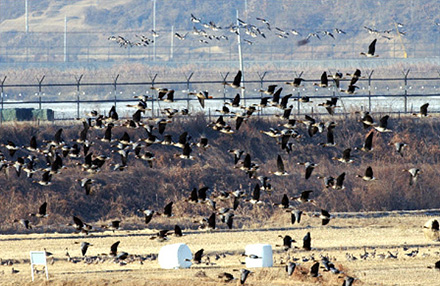
The DMZ is home to black bears, mule deer, Chinese egrets, Manchurian cranes, black-faced spoonbills and swan geese, to name a few. There are also ugly pigs and _ some people say _ the beautiful and elusive Amur leopard, of which only 30 are known to have survived in Russia.
The DMZ is host to this diversity of life strictly because it is a no man's land. Thousands of landmines and hundreds of kilometers of concertina wire keep out the only specie capable of ruining such a fine show _ homo sapiens.
We must preserve this treasure trove of biodiversity, at any and all costs.
The irony of the situation is that if and when peace comes to the peninsula we could lose the only truly peaceful place there is: the DMZ. Should ``peace'' come to the peninsula and the razor wire come down one can rest assured the big developers will move in immediately, brandish their steely knives, and slice and dice the place to death.
No matter the outcome of South and North Korean peace talks, no matter the future of unification, regardless of the proliferation of ``special economic zones,'' the DMZ must be kept as it is: a green corridor in a land long beleaguered by too much concrete.
This four kilometer wide by 150 kilometer long belt of biodiversity crossing the Korean Peninsula and linking the East and West Seas must be preserved at all costs.
In this world of dwindling opportunities we must hold on to and protect dearly every bit of life we have left. Let's keep the DMZ a place of peace.
Rick Ruffin is a veteran writer and recipient of the Kalakbay Award. He is currently senior editor of Korea Economic Report magazine. He can be reached at rick_ruffin@yahoo.com.
Birds Korea 1108 Ho, 3 Dong, Samick Tower Apt., 148-22, Namcheon-Dong, Su-Young-Gu
Busan, 618-762 Republic of Korea