Saemangeum: 21 April 2006: The Last Gap in the Sea-Wall is Closed
"We were so busy we haven't had the chance to look back and think about what this means," Kim Wan-joong, a director at the state-run development corporation, said from the site by telephone. (Reuters)
South Korean workers closed the last remaining gap in a massive sea wall on Friday, completing a map-altering reclamation project after 15 years of work and bitter legal challenges by conservationists.
The project creates one of the biggest land reclamation projects in history covering about 400 square km (155 square miles) -- more than six times the size of Manhattan.
Conservationists and some residents have criticized the project as a potential environmental disaster that will destroy fishing assets, kill rare migratory birds and worsen the water quality of the rivers that feed into the tidal flat.
The government says it is desperately needed to breathe life into the declining region of Saemangeum, which refers to the massive bay located on the west coast of the Korean peninsula.
Good weather conditions allowed the work of plugging the last remaining gap in the 33-km (20.5 mile) sea wall to finish three days ahead of schedule, officials at the Korea Rural Community and Agricultural Corp., which is supervising the project, said.
"We were so busy we haven't had the chance to look back and think about what this means," Kim Wan-joong, a director at the state-run development corporation, said from the site by telephone.
The government has yet to finalize how to use the reclaimed land and fresh-water lakes that will be created inside the sea wall, but officials have said they envision there will be farmland and parks that will spur development in the region.
The project was conceived when South Korea was having trouble feeding its people after the 1950-53 Korean War and wanted to increase agricultural production.
These days, farmers in the area are getting fewer in number and up in years. Local farmers said there will be no one to farm the land and the much of the land will be useless for farming because it will likely be too saturated with salt from sea water.
Conservationists said the project, by choking the tidal flats and killing the shellfish and young fish that rare shore birds feed on, will probably lead to the extinction of some bird species.
(c) Reuters 2006. All Rights Reserved.
16 March 2006: Saemangeum - Judges Rule that Reclamation may continue.
Proponents of the reclamation project have announced that they will hold a "ceremony" to celebrate the completion of their 33km long seawall on April 24th 2006 - right before the very highest tides of the spring, during the peak of shorebird northward migration.
540 m-wide sluice gates will then remain open after sea wall closure for a year or two (instead of a 30km wide natural estuary mouth), with greatly reduced water exchange and tidal-range. Forecast models show the whole Saemangeum basin first being flooded with water - leaving very few tidal-flat areas for foraging birds - before most is left to dry ready for so-called development.
Incredibly, wider-scale forecast models (produced more than a year ago by a government related institute) suggest that this single massive reclamation project will lead to a 30 cm rise in sea level in much of the Yellow Sea, causing a Sea-wide loss of a further 5% of tidal-flats (and presumably leading to more intense flooding of salt-marsh which support breeding colonies of Saunders's Gull).
Moreover, this project will then be followed next month (according to local activist Mr. Chu Yong-Gi), by the start of reclamation of the neighboring Geum estuary - another key site for Great Knot and also for Eastern Oystercatcher (supporting 50% of the minimum total population estimate of the distinctive osculans taxon).
It is absolutely clear that the impacts on a broad range of shorebirds and other specialised tidal-flat species by these reclamation projects will be enormous.
This April 24th timing of the Saemangeum seawall completion, the total disregard for its region-wide impacts, followed by the rather secretive intention to reclaim the Geum, not only reveal absolute ignorance of the area's international importance to migratory shorebirds and other waterbirds, but also the obvious hollowness of all PR claims that this kind of reclamation is being conducted with due concern (actually any concern) for the environment.
For all us who are genuinely concerned with tidal-flat conservation and for the future of extraordinarily charismatic species like Spoon-billed Sandpiper and Great Knot, there is a clear need to continue challenging these projects, both of which fly so very clearly in the face of domestic obligations to various international conservation conventions.
One key response so far has been the development of a Saemangeum Shorebird Monitoring Program (Time To Act), now being conducted by members of Birds Korea and the Australasian Wader Studies Group (AWSG). Working with other individuals and groups, the Program team aims to gather shorebird data through this spring, and again in 2007 and 2008, at both Saemangeum and the Geum.
Counts in the area conducted from March 31st show that shorebird numbers are already building rapidly, with the first Mongolian Plover, Red-necked Stint and Common Greenshank recorded on April 2, the first Ruddy Turnstone on April 3, and the first Terek Sandpiper and Black-tailed Godwit on April 4. During four and a half days of counts, internationally important numbers of Dunlin, Far Eastern Curlew and Great Knot have already been recorded, while Bar-tailed Godwit have started to increase dramatically (at one roost 230 birds on April 2 had built to 930 by April 3). In addition, at least three Bar-tailed Godwit individually marked in New Zealand have already been documented.
Numbers of shorebirds are expected to peak in late April, when it is anticipated that over 200 000 will be present. In addition, small numbers of Saunders's Gull have been seen daily, while on April 3rd, 15 Hooded Crane and 4 Black-faced Spoonbill were also seen within the Saemangeum system.
With such a massive conservation challenge ahead we continue to invite all interested persons to join us, in whatever way, in documenting and publicising the loss of South Korea's most important estuarine system - Saemangeum - the site identified by Mark Barter in his key 2002 study as the single most important known site for shorebirds in the Yellow Sea. We invite all persons to help us increase pressure to maintain tidal-flow in the Saemangeum system; and to help domestic groups in Korea to stop the reclamation of the adjacent Geum estuary...
The evidence we gather and the analysis we present through the Saemangeum Shorebird Monitoring Program will be provided (freely and openly) in the coming months and years to raise awareness of the impacts of reclamation domestically; and also as an example of the impacts of reclamation on shorebirds region-wide.
Additionally, our intention now is to include this new information with data we have already collected for a number of previously published Reports, and to produce a full assessment on how shorebirds have been affected by massive reclamation projects over the last ten years. This Report will be presented by Birds Korea at the Ramsar Conference being held in South Korea in 2008.
The threats to East Asia's shorebirds are not simply going to go away. Over the coming weeks we will be co-ordinating our plans for producing our Report for Ramsar. IF YOU CAN OFFER LOGISTICAL OR FINANCIAL HELP PLEASE CONTACT US. In the meantime, please mail your concerns to South Korean embassies where you live; put us in touch with environmental media where you live; offer technical support and advice to the Monitoring Program; and please help us to ensure that the terrible costs of the Saemangeum and the Geum reclamations become known, and the potential benefits of conservation become much better recognised.
16 March 2006: Saemangeum - Judges Rule that Reclamation may continue.
The Supreme Court today that despite objections, the Saemangeum Reclamation may now continue. The decision to re-start construction now lies with the Ministry of Agriculture.
Saemangeum - According to newspaper reports, Judges are going to make their final ruling on whether the Saemangeum Reclamation Project should be halted or not at 2 pm on Thursday, March 16th at the Supreme Court.
South Korean environmentalists, religious leaders and local fishers are of course working very hard to stop the reclamation project.
Local fishers organized a big rally yesterday, March 06. About a thousand local fishers gathered at the southern end of the sea wall to urge the Korean government to finally stop the project. An excellent series of photos are posted at the internet address below.
(NB there are about twenty photos and the download time on a dial-up connection will be quite long.)
http://nongbalge.or.kr/bbs/view.php?
Also taking part was Prof. Kim Yong-Ok, a Professor Emeritus at Suncheon University. An author of 32 books, he is one of Korea's most respected and influential intellectuals, with a huge TV following. Formerly a journalist and a full-time professor, he now studies and teaches a wide range of disciplines pertinent to Korean culture and history. On March 6th, he wrote an open letter to the people of Korea, in which he condemned the reclamation of Saemangeum – calling it a historic issue, and one which he must oppose, as a conscientious objector. The same day he stood symbolically in front of a bulldozer at Saemangeum and asked others of good conscience to join in opposition to the reclamation project.
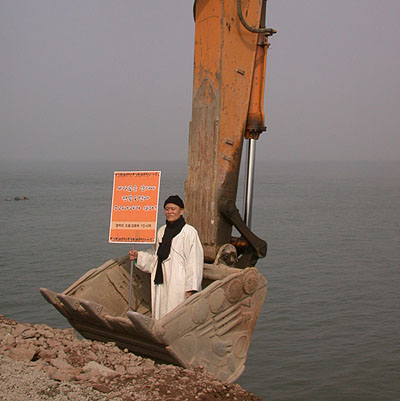 Professor KIM Yong-ok, photo © Mr. Chu Yong-Gi
Also notable, from today, March 07, religious leaders including Father Mun Gyu-Hyun are going to start a hunger strike in the middle of downtown Seoul.
February 2006: "Sea-wall due to be completed April THIS YEAR".
Birds Korea is grateful to Ma Yong-un of Korean Federation of Environmental Movements (KFEM) for clarifying the following (terrible) information: "The government is planning to start the work to close the two openings in the Seawall on March 24 and finish the closing in April, this year, 2006. They have finished construction of the two sluice gates and brought in huge amounts of rocks and stones next to the seawall, to close the openings. And, I think they can finish the closing work by the end of April as I have seen their work on the No. 4 seawall, the longest one between Yami-do and Bieung-do in 2003.
After closing the seawall they will regulate water level inside the wall with two sets of sluice gates; one set in Garyeok-do (240m long) and the other in Sinsi-do (300m long). They plan to lower the water level 1 meter to dry up some of tidal flats to develop further.
There is a small hope that we might still get a positive result from the Supreme Court. The main judge in charge of the Saemangeum case is famous for progressive rulings in the past. He cancelled two Hotspring development projects near Songni-san National Park in late 1990s. The case was raised by local people and the KFEM Cheongju office."
However, as well as the court appeal, overseas researchers have said that they definitely still want to undertake the "Saemangeum Monitoring Programme" this spring, and KFEM are preparing - with input from Birds Korea - another petition that they plan to submit to the appeal hearing.There's no doubt that the most important wetland for migratory waterbirds in East Asia is now in imminent danger of being lost, but Birds Korea and other Korean environmental NGOs are not giving up just yet...


2006
Copyright 2002 - present http://www.birdskorea.org all rights reserved
Birds Korea 1108 Ho, 3 Dong, Samick Tower Apt., 148-22, Namcheon-Dong, Su-Young-Gu
Busan, 618-762 Republic of Korea
Birds Korea 1108 Ho, 3 Dong, Samick Tower Apt., 148-22, Namcheon-Dong, Su-Young-Gu
Busan, 618-762 Republic of Korea