


Nial Moores, as consultant for the Upo Wetlands Centre, February 2003
With editing by Charlie Moores
Introduction
Part of the Nakdong River floodplain, Upo is both beautiful and internationally important, and one of only two Ramsar sites nationwide. Designated in 1998 Upo is a relict area of floodplain wetland, supporting local farmers, fishers and a rich and representative biodiversity. It is also home to the Upo Wetlands Centre, a small but leading wetland conservation NGO. Threatened by numerous development projects, critical to migratory bird populations, included in several government initiatives, and visited by large numbers of nature-lovers and sightseers, Upo can be considered a test case for the management of inland wetlands in South Korea. To develop the most effective solutions and management approaches for the conservation of Upo, it is desirable to gather and share significant input from as broad a range of opinion as possible. The Upo Wetlands center and WBKEnglish therefore intend opening up the discussion process to include members of the local population as well as the broader international conservation community. This introductory note is therefore presented here as a preliminary part of the Upo Wetland Centre's Longterm Strategic Planning Project, and will be developed and extended over the coming month's on the centre's website at:http://eng.upo.or.kr/main.
As always, we welcome your input and advice.
South Korea's globally important Wetland Bidiversity
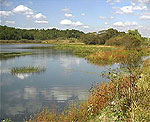
Photo © Charlie Moores
South Korea's importance to migratory waterbirds and other wetland biota is becoming increasingly well-documented and understood, both domestically and by the international conservation community. The country's wetlands collectively support over a million Anatidae in winter, probably even larger numbers of shorebirds during migration, and significant populations of 13 or more globally threatened waterbirds. The 60-65 extant internationally important wetlands (based on Ramsar waterbird criteria) that largely support these waterbirds can be broadly subdivided into two types: intertidal and freshwater. In a mountainous country with one of the highest human population densities in the world and one of the highest water demand rates , South Korea's freshwater wetlands, which once comprised free-flowing major rivers, extensive floodplain wetlands and several extensive delta systems, now consists largely of bunded and controlled rivers, nearly a million ha of rice-field with recently-created reclamation lakes, and fragmented and relict areas of floodplain. Almost all artificial or semi-natural freshwater wetland is heavily utilized. Natural or near-natural floodplain wetland areas, supporting a historically representative wetland biodiversity, now probably total less than 10 000 ha nationwide . Most are contained in the inaccessible DMZ, shared by the North and South, and the remainder in increasingly isolated fragments adjacent to the Nakdong, Korea's longest river, in the southeast.
Waterbirds that historically depended on this once extensive complex of floodplain wetlands include a significant number of now threatened species, including three species of crane, the nationally extirpated Crested Ibis, the Oriental White Stork (lost as a breeding species to South Korea in the 1980s), Swan, and Lesser White-fronted Geese, and the spectacular Baikal Teal. In addition, a wide range of other species typically associated with flood plains has also apparently undergone very significant declines: most species of bittern, the once-widespread Watercock, and most geese, especially the shallow-lake preferential Eastern Taiga Bean Goose.
Beyond their importance to waterbirds, historic floodplain also played a key role in storing flood waters, in helping to improve water quality flowing into inshore waters, in supporting the flood pulse nutrient cycles critical to the fertility both of farmed land and estuarine ecosystems, and in maintaining both inland and inshore fisheries. Their loss has meant significant declines in biodiversity and has contributed enormously to problems of water quality, including the rapid growth of algal blooms in inshore waters around all three coasts which are devastating to marine aquaculture and fisheries.
Continuing urbanization and industrialisation, excessive water extraction and unsustainable use of other wetland resources nationwide (and in much of eastern Asia) will inevitably lead to continuing loss of natural floodplain function, and the extinction of all but the most tolerant and robust species. At present as most natural floodplain has already been converted and degraded, the majority of floodplain associates (including small numbers of wintering Oriental Stork and 90% or more of the world's population of Baikal Teal) are now largely confined in South Korea to recently reclaimed coastal wetland areas: reclamation sites that temporarily still supply floodplain-like conditions, and still lack the infrastructure and ecological limits of intensively used farm land. Already lost to estuarine specialist species, these newly and accidentally created wetland areas "succeed" into more typical intensive farmland (as in Haenam Gun) and specialized floodplain species then also decline.
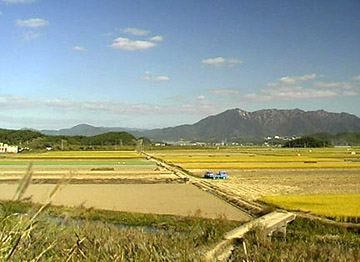
As the era of large-scale coastal reclamation comes to a close in South Korea, remaining populations of many floodplain waterbirds will likely decline significantly. Their survival in Korea will then in the first depend on effective conservation of remaining key sites such as Upo and Joonam reservoirs (part of the same Nakdong system); and in the second increasingly on shifts in the management regime of extensive artificial and semi-natural wetland created through reclamation. Restoration of reclaimed areas (comprising rice-fields, reclamation lakes and reed-filled ditches) to near-natural wetland is a politically unacceptable option at present, and they will need to be managed increasingly both to produce food and to maintain wildlife populations. For these populations to be sustainable long-term, management of all areas will need to be based on research into wetland function and target species' ecological requirements in remaining (near-) natural floodplain wetland areas, and on resultant successful management approaches developed at these select ecologically complex and integral sites. To win acceptance and support, any subsequent shift toward management for wildlife in already utilized areas (i.e. all areas outside of the DMZ) must also lead to increased benefits for direct and indirect human users. This is an extremely difficult challenge in one of the world's fastest growing economies, and in a nation lacking (1) adequate political frameworks, (2)specialized NGOs, or (3) a culture of biodiversity conservation.
Set in such a context, the successful conservation of Upo wetland has enormous significance. Although small, its ecological character and status as a Ramsar site means Upo already has a critical role as a relatively secure gene-bank for floodplain species and for maintaining existing waterbird and other species' populations. It is also the site of choice for developing appropriate freshwater wetland management techniques involving local communities that can later be applied elsewhere in the country.
The wetland itself: location and area
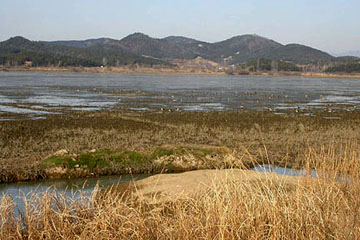
Upo wetland (also spelt Woopo) is located at 35 Degrees 33' North, 128 Degrees 25' East in Chagnyeong Gun, Gyeongsannam Province, 8 km northwest of Changnyeong town, and 4-5 km east of the Nakdong River (some 70 km upstream from the estuary). Although 854 ha are designated under the Ramsar Convention, much of the site actually comprises low hills, secondary woodland, leek and onion fields and other non-wetland habitats.
Part of the historic Nakdong River floodplain, the modern landscape of Upo is believed to have formed largely over the past 10 000 years, with subsequent large-scale modification for agriculture both of surrounding areas and of parts of the Upo wetland lakes themselves (most markedly since the 1970s).
The wetland areas proper now comprise small streams and four shallow lakes (Upo, Mokpo, Saji Po and Jokibeol), which between July and September tend to flood annually to a depth of several metres following monsoon rains and occasional typhoons. After such rain events, the water surface expands slightly to cover a maximum of ca 230 ha.
During the autumn and winter there is a slow draw-down (due to drainage, evaporation and use for agriculture), and the main lake then reveals a broad margin of mud and exposed plant roots, favored by feeding Eastern Taiga Bean Geese. Water levels tend to remain very low until the first heavy rains (in late April or early May), gradually filling the lakes and spilling over to cover adjacent agricultural land again in the late summer.
This flood regime, once considerably more dynamic and extensive, is now largely restricted by the construction of bunds and drainage systems, with further such infrastructure being proposed - at great economic and ecological cost.
Upo Wetland's Biodiversity
Despite such development, and its heavily exploited hinterland, Upo is still widely considered to be one of best remaining wetlands nationwide, and has therefore been included in a large number of research projects and government initiatives. According to preliminary information contained in draft government documents (e.g. prepared for the UNDP-GEF PFD-B), approximately 168 species of aquatic plant (including the nationally rare Thorn Lotus Euryale ferox, Frogbit Hydrocharia dubia and Water Persicaria Persicaria amphibia); 55 species of aquatic insect (including the rare Cristaria plicata ); 28 species of fish; 11 species of reptile; 9 species of amphibian; and 12 species of mammal have so far been recorded at Upo.
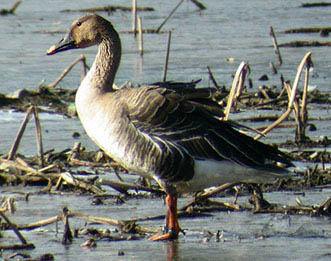
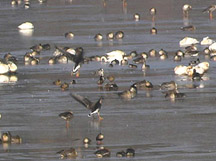
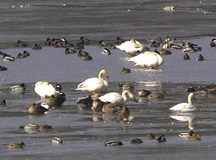
In addition, the wetland regularly supports 3.000 plus Eastern Taiga Bean Goose (many giving excellent views), as well as several hundred Whooper Swan, small numbers of White Spoonbill and near-annual Oriental White Stork. Migrant species include both White-naped and Hooded Crane while breeding species include several pairs of Yellow Bittern and at least in 1998 probably a single pair of Falcated Duck (presumably the only nesting record nationwide).
Towards Wise Use
The wetland and its hinterland supports a large number of farming and fishing households, which are generally economically disadvantaged and aging. Prior to declines in native fish species (caused largely by changes to the wetland, declining water quality and the introduction of Bass and American Bullfrogs into Korea) many local men made a living by fishing at Upo, while women harvested water snails for sale in the local market. Following Ramsar designation in 1998, outside fishers (largely recreational) have been banned, and the numbers of people dependent directly upon wetland "products" have also continued to decline. Farmers, however, who mostly grow onions, leeks and garlic (with significant inputs of pesticides and fertilizers), still work much of the hinterland and catchment. In an attempt to improve water quality and the wetland's ecological character the Ministry of Environment and Changnyeong Gun have so far bought up ca 50 ha of arable land closest to the lakes, with the aim of restoring it to wetland. Further moves, including encouraging organic farming and helping local farmers market their produce in return for reducing pesticide use, are also presently under discussion by several local organizations, including the Wetlands Center.
Upo is one of the most well-known and well-visited wetlands in the country, and has been a center of environmental education and conservation activities since the mid-1990s. NGOs and sections of government have been active for a number of years, winning Upo's designation as an Ecological Conservation Area in 1997 and as a Ramsar site the following year, with the support of the local government. The national Ministry of Environment (MoE) has also been very active in surveying and monitoring the wetlands' biodiversity, and has identified Upo as one of the three demonstration sites nationwide in the ongoing UNDP-GEF Wetlands Biodiversity Project. It also forms a significant node in the Nakdong River Basin Conservation Initiative, developed by the MoE in response to its obligations under the Wetlands Conservation Act (1998), and under the National Ecological Network Strategy (2002). Such initiatives all but ensure that significant government effort (both local and national) will continue to be focused on Upo.
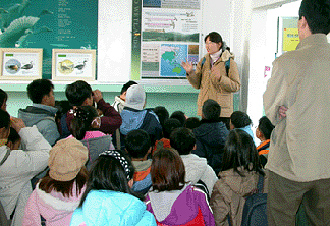
Representative teaching at the Center
Photo © Upo Education Center.
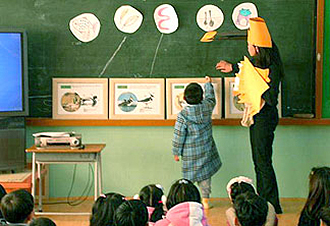
Photo © Upo Education Center.
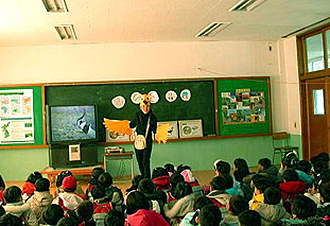
Photo © Upo Education Center.
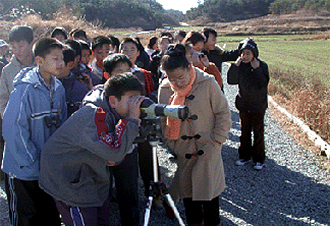
Photo © Upo Education Center.
NGOs too remain extremely active and are evolving to take a more significant and valuable role. The Upo Wetlands Centre, housed in a large and renovated former school building, falls under the umbrella of the Changnyeong KFEM, and supports programs monitoring waterbird populations; organizes and conducts school education visits; guides and educates visitors; and is increasingly taking the lead in trying to find solutions that can benefit both wildlife and stakeholders.
With South Korea's rapid socio- and economic maturation, new models for challenging wetland loss and degradation urgently need to be developed: models that are based on cooperation and on seeking benefits for stakeholders as well as the wildlife. Upo Wetlands Center's Long-term Strategic Planning Initiative (with its mission statement of "Maintaining and enhancing Upo wetland's values and functions for 50 years and beyond, through benefiting local communities") aims to develop a framework for effective conservation.
We ask for your help in realizing this work.

For more information on Upo and the threats to its character and biodiversity, or to offer support (technical or financial) to the center, please e-mail Birds Korea or Upo Wetland Centre, and access the centre's new website at:http://eng.upo.or.kr
Also see the draft consultancy paper Conservation of Upo and the People and Wetlands Program.