


This Update covers September 1st - September 30th 2007. It is in three parts:
Warming temperatures in Korea have resulted in increasingly hotter summers and milder winters (with several colonizing “southern” breeding species and some surprising over-winterers). However, there has been relatively little research up to now to try to evaluate the impacts of global warming on the dates of migrant arrivals. Now, according to the National Parks Migratory Bird Centre (http://npmbc.or.kr), some migrant species do indeed appear to be arriving in Korea earlier in the spring (The Dong-A Ilbo news Aug 30th). This phenomenon likely has multiple implications for the breeding success of both migrant and resident bird species.
In contrast to most recent conservation news items, finally some good news – this time contributed by Mr. Jang Yong-Chang of the Jeju Birdwatchers Group. The Jeju Birdwatchers Group has been working hard to protect the habitat of Korea’s only wintering Black-faced Spoonbills Platelea minor. As Mr. Jang Yong-Chang reports: “On September 14, 2007, the Korean National Trust announced the result of the 5th Contest of Natural/Cultural Heritage Candidate Site. Here, Ojori Bay-Spoonbill habitat in Seongsanpo, Jeju Island, was selected as one of eight Natural/Cultural Heritage sites that should be protected. In this contest, managed by the Korean National Trust and supported by Yuhan-Kimberly, the Ministry of Environment, the Ministry of Maritime Affairs and Fisheries, the Forest Management Agency, and the Korean Forest Database, the sites were selected by review of documents, Netizens’ comments and field surveys. The Trust is selecting such sites to arouse the value of the natural/cultural heritages and the need to protect them. Jeju Birdwatchers Group, who filed the application, is delighted to announce this news to all the people who are concerned about the Black-faced Spoonbills’ habitat in Jeju,. And we hope that Ojori Bay Wetland, a natural lagoon in a volcanic region that is home to more than 160 species of birds, will also be designated as a legal protected area by Korean Government in the near future.”
September was another very busy month for Birds Korea, and another month very much focused on shorebirds – one of the region’s most threatened group of birds. Work included shorebird counts at the Geum Estuary; the production of our annual newsletter (adorned with an image of a Nordmann’s Greenshank on the cover, created for us by Mr. Ed Keeble); support work for an exhibition (September 14th-October 16th) and presentation at a symposium on shorebirds on September 14th, both at the Mokpo Natural History Museum (MNHM) ; and a shorebird seminar at the Nakdong Eco-centre, held jointly with the Nakdong Estuary Conservation group (Nakdong Hagu Moum), on September 21st (read more: here).
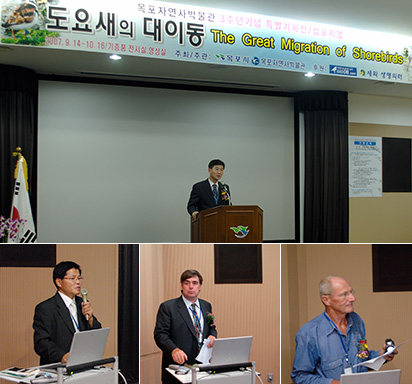
From left to right: Dr. Kim Seok-Yee MNHM, Mr. Nial Moores Birds Korea, Mr. Jan van de Kam Birds Korea presenting at the symposium
Photos © Andreas Kim
The Great Migration of Shorebirds” events in Mokpo (a month-long photo exhibition and a one-day symposium) were organized by Dr. Kim Seok-Yee of the Mokpo Natural History Museum, supported by leading local Birds Korea activist Mr. Andreas Kim, and national website-based group BirdDB (see: http://birddb.com/), who contributed many wonderful images of shorebirds from around Korea. Presentations at the symposium were made by several representatives from the museum and Mokpo City, as well as by Birds Korea (Mr. Nial Moores and Mr. Jan van de Kam) and Mokpo KFEM.
Most shorebird fans will already know the name of wildlife photographer Jan van de Kam, through his exceptional publications, including Shorebirds: An Illustrated Behavioral Ecology. Mr. Jan van de Kam is also a Birds Korea international member – and since April 2006 (when he first came to Korea as part of the 2006 Saemangeum Shorebird Monitoring Program) he has been dedicating his time and energies to a new book project: Shorebirds of the Yellow Sea. Over the past 18 months, he has been traveling the East Asian-Australasian Flyway, following the birds through their annual cycle, taking thousands of images of shorebirds and their threatened habitats from New Zealand and Australia in the south (where many of our shorebirds spend our winter), in the Yellow Sea (in both China and Korea) and north to their breeding grounds in Siberia and Alaska.
During September, accompanied by Ms. Jan Lewis, Mr. Jan Van de Kam traveled the west and south coasts of Korea, and presented some of his images at the Mokpo Symposium and the shorebird seminar in Busan.
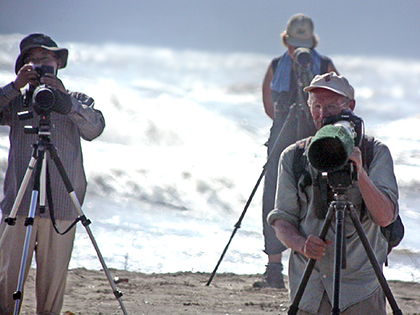
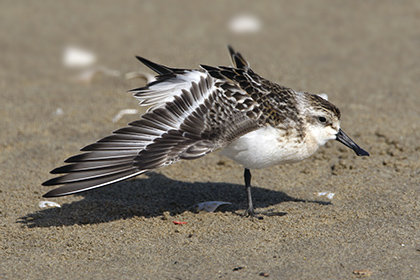
The shape and final contents of his next book, The Shorebirds of the Yellow Sea, are still being decided – with the aim of presentation at the next Ramsar Convention conference, here in Korea in October 2008. Considering the scope and aims of the work (to raise awareness about the shorebirds and the Yellow Sea), we are inviting photographers in Korea to contribute some of their wonderful images to proposed photograph exhibitions (such as those held in 2007 in Iksan and Mokpo), and for possible use in this book. We are looking especially for very well-composed images (e.g. not digi-scope images) of shorebirds and threats to their habitats; images of the Yellow Sea tidal-flat and key sites in winter; and images of positive conservation actions for shorebirds. If you would like to contribute your images (all of which will be fully acknowledged), for use in exhibitions or for consideration for use in Shorebirds of the Yellow Sea, please contact Birds Korea. Thank you!
Further media work and coverage of Birds Korea’s work in September included a day-long interview of Mr. Nial Moores by National Assembly Television and an interview with KNN TV, the latter on Spoon-billed Sandpipers and the Nakdong Estuary. Further telephone interviews were also conducted with media from France and Australia. Meanwhile, overseas, the September edition of Birds Australia’s lavishly illustrated magazine Wingspan also contained an excellently-written five-page article by Dr. Danny Rogers (with images by Mr. Jan van de Kam): “The End of Saemangeum.” Clearly, Saemangeum remains a major environmental issue of international concern.

To register your own concerns about Saemangeum, and to urge the conservation of the Geum Estuary, please go to: www.restoresaemangeum.com
Birds Korea work in October includes attending a meeting of the Yellow Sea Partnership in Busan (on October 1st); meetings with leading Spoon-billed Sandpiper researchers in mid-October, and support for an international press alert on the species; conducting a class on birdwatching (organized by the Geum River Basin office of the Ministry of Environment); providing assistance to visiting Avian Influenza researchers from the international Wildlife Conservation Society; and final production of the much-anticipated 2007 SSMP Report.
Exceptional highlights in September include two national firsts. There was a Buff-breasted Sandpiper Tryngites subruficollis in the Nakong Estuary on September 2nd, photographed by Park Chung-Rok. Although Buff-breasted Sandpiper is already listed both by Won (2000) and Park (2002) (apparently based on a record of one collected on April 27, 1972 in Shiheung and published by Fennell, presumably the same year), the same author actually died in January 1972, three months before the record! Considering the error in the date or documentation, the 2007 Buff-breasted Sandpiper therefore becomes the first acceptable Korean record. On September 13th, a Wood Warbler Phylloscopus sibilatrix was photographed at range on Tok-Do in the East Sea by Kim Jae-Woon, and posted as an unidentified warbler on the National Parks Bird Centre website. Review of the two images reveals several diagnostic features of the species, in combination confirming identification as Korea’s first Wood Warbler (please go to the: Korea National Park website). This European species has proven to occur very rarely, though regularly, in neighboring Japan, especially on the East Sea island of Hegura.
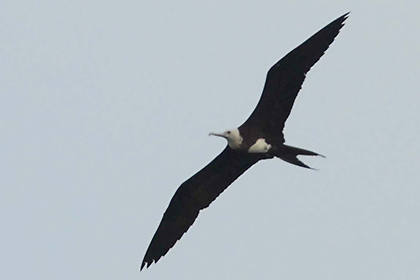
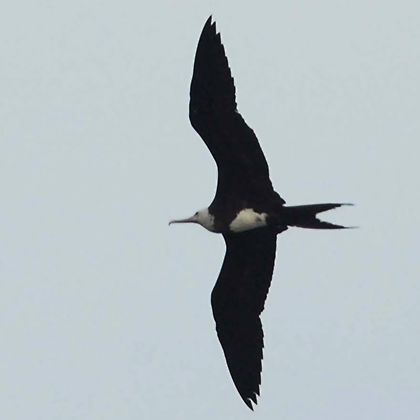
at Gapa Island, South of Jeju. August 22, 2007
Photo © Kim Byung-Su

Socheong Island, May 20, 2007
Photo © Thomas Langenberg
Further exceptional records during September included Korea’s third record of Black Tern Chlidonias niger at Okgu Reservoir, Gunsan (photographed by Peter Nebel on 2nd), confirmation of successful fledging of four Pheasant-tailed Jacana Hydrophasianus chirurgus at Joonam Reservoir (though breeding was unsuccessful at Upo Ramsar site), and national high counts of at least 30 Whiskered Chlidonias hybrida and 265 White-winged Tern C. leucopterus at Okgu Reservior on September 7th (Peter Nebel).
Only a few records were received of species of special conservation concern. At Saemangeum (until barrage closure in 2006, the most important shorebird site in the Yellow Sea), there were 2 Nordmann’s Greenshank Tringa guttifer on 12th (Nial Moores, Ju Yong-Ki, Jan van de Kam, Jan Lewis), increasing to at least 15 at the same small location on 29th (Nial Moores, Peter Nebel, Tim Edelsten) , while there were also 4 at Yubu Island in the Geum Estuary on 12th (Nial Moores, Ju Yong-Ki, Jan van de Kam, Jan Lewis), increasing to 13+ there on 28th (Nial Moores, Ju Yeong-Ki, Tim Edelsten, Kim Shin-Hwan). One Nordmann’s Greenshank was also very well-photographed on September 22nd at the Nakdong Estuary by Kim Beom-Su. The now even rarer Spoon-billed Sandpiper Eurynorhynchus pygmeus was reported only from Yubu island in the Geum Estuary, with 13 on September 12th (Nial Moores and Ju Yong-Ki) and 11 there on September 28th (Nial Moores, Ju Yong-Ki, Kim Shin-Hwan and Tim Edelsten) and at the Nakdong Estuary, where there were at least 4 juveniles on September 19th and 20th (Jan Lewis, Nial Moores, Jeon Shi-Jin, Kim Beom-Su and Jan Van de Kam) with apparently two still present there on 22nd (via Ju Yong-Ki). Birds Korea is an active member of the international Spoon-billed Sandpiper Recovery Team, and would therefore warmly appreciate receiving all records also of this species – from Korea and the wider region.
Other shorebirds of note in Korea during the month included at least 3 Common Ringed Plover Charadrius hiaticula (Nial Moores, Jeon Shi-Jin, Jan Lewis, Jan Van de Kam, Kim Beom-Su) between 19th and 20th and a Little Stint Calidris minuta (not photographed), on 20th (Nial Moores), both at the Nakdong Estuary.
Three older news items include two from August and one from May. Further confirmation of identification of Korea’s second Great Frigatebird Fregata minor (at Gapa Do, south of Jeju, on August 22nd) comes through comments by David James (many thanks), and a further series of images of this bird kindly provided by Kim Byung-Su; while there was also a Lesser Frigatebird Fregata ariel photographed at Hadori, South-east Jeju on August 17th (news via Jang Yong-Chang). Finally, belated confirmation comes of a Manchurian Reed Warbler Acrocephalus tangorum photographed on Socheong Island by Thomas Langenberg on May 20th (many thanks to Paul Leader for also commenting on the image): this is apparently only the third record of this species in Korea supported by photographs.
Finally, a gentle reminder to all of our members, past and present, living in Korea. Birds Korea depends entirely on the support of our members and volunteers. Donations and domestic membership fees are vital to us! Please renew your membership (annual membership fee is only 30.000 Korean won; and life-time membership only 150.000 Korean won at this time), and help us to help the birds!
Birds Korea, October 3rd, 2007.