


Birds Korea, December 22nd, 2014
On December 19th 2014, the Scientific Task Force on Avian Influenza and Wild Birds released a revised statement on “H5N8 Highly Pathogenic Avian Influenza (HPAI) in poultry and wild birds”. This revised version excludes the reference to the highly inappropriate recommendation calling for a cull of wild birds in outbreak areas. As we understand it, this is because this recommendation ran counter to international best practice and conservation obligations, and so was removed pre-publication by the editors of the journal following a letter of concern initiated and sent by international experts, co-signed (at these experts’ invitation) by Birds Korea.
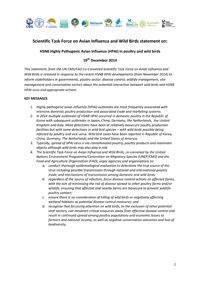
The revised text of the
Task Force Statement
H5N8 Highly Pathogenic Avian
Influenza (HPAI) in poultry
and wild birds
December 19rd 2014
Although the removal of such a recommendation from an international journal is encouraging, it will of course not necessarily result in any change in thinking, policy or practice. For the past two weeks, Birds Korea has therefore also continued to raise concerns with members of the Task Force and other lead specialist bodies over the inclusion of the assumption in the latest Task Force Statement about the role of wild birds “likely” infecting poultry held in poultry-factories. This is the assumption that lies behind calls for wild bird culls. And yet, based on literature review and communication with leading specialists, there is no hard evidence anywhere of wild birds directly infecting poultry held in biosecure facilities.
Based on the best available scientific evidence, we continue to believe that it is the industrial production and movement of poultry that has created the conditions required to maintain and spread strains of Highly Pathogenic Poultry Flu; it is the modern poultry industry that causes enormous suffering for billions of animals; and it is the modern poultry industry that has led to a substantial increase in outbreaks of Poultry Flu in wild birds. It therefore seems that the best ways to stop the rise of Poultry Flu will be for people to choose a poultry-flu diet, and for the industry to move away from the present system of production and transport.
With the aim of supporting policy responses in the ROK and elsewhere with best science, we would also like to highlight a report looking at outbreaks of Highly Pathogenic avian influenza A subtype H5N8 published this month by the European Food Safety Authority (EFSA Journal 2014, 12 (12): 3941), now accessible at:
http://www.efsa.europa.eu/en/efsajournal/doc/3941.pdf
Examining recent outbreaks in Europe, this expert report finds that, “Direct contact between wild birds and farmed birds in the affected holdings was unlikely. It is more plausible that indirect introduction of HPAI H5N8 to poultry holdings via humans, vehicles, equipment, fomites, live animals and/or animal-derived products contaminated with virus (for instance in faeces) of infected birds took place” (EFSA Journal 2014).
The Abstract from this EFSA report is reproduced below in full:
Abstract
Highly pathogenic avian influenza (HPAI) H5N8 outbreaks in poultry farms have been reported in Asia and Europe since January and November 2014, respectively. The entry of HPAI H5N8 into Europe and its subsequent spread within Europe are two separate events with possibly different transmission vectors. Following epidemiological investigations of infected poultry holdings, there is not yet a clear indication of the source of the virus. There are no known direct bird migration routes from Asia to western Europe. It has been hypothesised that long-distance transmission of HPAI viruses could occur as a result of cross-infection between different birds in north Eurasian breeding areas, but this hypothesis needs further investigation. HPAI H5N8 has been detected in wild bird populations in Germany and the Netherlands. Direct contact between wild birds and farmed birds in the affected holdings was unlikely. It is more plausible that indirect introduction of HPAI H5N8 to poultry holdings via humans, vehicles, equipment, fomites, live animals and/or animal-derived products contaminated with virus (for instance in faeces) of infected birds took place. Investigations in the Netherlands suggest separate introductions into four holdings and one between-farm transmission. Assessing biosecurity procedures is recommended with a focus on segregation, cleaning and disinfection, and improving where necessary. Given the apparent low pathogenicity of HPAI H5N8 for several wild bird species, focused strategic and proportionate enhancement of active and passive surveillance of living and dead wild birds in the high risk areas would improve the understanding of the risk of virus transmission to poultry. It might also facilitate the design of targeted measures to reduce the risk of virus transmission between poultry and wild birds. Timely updated analyses on the evolving situation within the European Union are required, as well as assessment of all transmission routes that might transport HPAI viruses from Asia to Europe.
from the Republic of Korea
Dr. Nial Moores, Birds Korea, December 4th 2014
Highly Pathogenic A (H5N8) was first detected in poultry in the Republic of Korea (ROK) in early 2014 (Task Force 2014). This novel strain of H5N8 poultry flu is one that most likely evolved within ducks in a duck farm, here in the ROK (Ku et al. 2014).
The outbreaks of this novel strain of H5N8 started on farms in the agricultural heartland of the Jeolla Provinces in the southwest of the country (like H5N1 some years before), then spread throughout much of the country. This spread was likely assisted by an initial movement of 173,000 ducklings from the outbreak farm to 24 farms in four provinces during the disease incubation period. The initial outbreaks also affected wild birds – with up to 100 waterbirds, many of them Baikal Teal Anas formosa, found dead at nearby Dongrim agricultural reservoir (GAIN 2014).
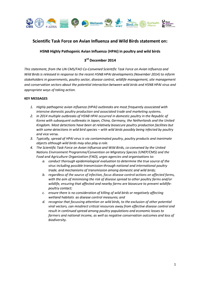
Scientific Task Force on
Avian Influenza and Wild Birds
statement on:
H5N8 Highly Pathogenic Avian
Influenza (HPAI) in poultry
and wild birds
December 3rd 2014
As in previous years, these outbreaks were quickly followed by assertions that wild birds (most likely Baikal Teal) were somehow infecting poultry, even though this would require them to penetrate bio-secure farms in each outbreak area, infect poultry and then escape, all undetected. Anyone who has seen even a small bird trapped in a building can imagine the ridiculousness of this Mission Impossible-type scenario, undertaken by flocks of ducks and geese. Nonetheless, there was little, if any, discussion in mainstream media about the level of biosecurity at poultry farms and factories, and no discussion about the possibility of poultry farms infecting local wetlands and waterbirds with virus, through e.g. poultry manure and wastewater run-off.
As in previous years too, culls of poultry were carried out and roadblocks with disinfectant sprays were employed in many parts of the country. A new measure in 2014 was the industrial-scale spraying with disinfectant of wetlands and waterbirds at a number of sites nationwide. This practice apparently continued for several weeks, even though it was contrary to advice earlier provided by leading experts who argued that disturbing waterbirds in and near outbreak areas simply increases the risk of spreading the virus to new areas.
Outbreaks in poultry in the ROK continued on into April. The Poultry Site (2014a) states that: “The veterinary authority sent Follow Up Report No. 5 dated 30 April to the World Organisation for Animal Health (OIE). The report described three new outbreaks of HPAI in poultry between 6 March and 21 April 2014. The first started on 6 March in breeding chickens in the region of Gyeonggi-do, the second in Sejong (also in breeding chickens) and the third outbreak started on 21 April on a farm with domestic geese in Chungcheongbuk-do.” Outbreaks at farms were then reported again in June. Again, The Korea Times reported that “Studies are underway to keep track of infection routes, as many believe migratory birds are to blame” (Kim 2014). This is even though the same report stated that it was known that poultry at the outbreak farm had been brought from another outbreak area shortly before; and even though this outbreak was several months after Baikal Teal and most other wild migratory waterbirds had left the country.
We then need to fast-forward only a few months to the next outbreak in the ROK, this time in September, again at a poultry farm, and again in the southwest of the country. Happily, no subsequent outbreaks have been reported yet, and there appears to be no published evidence of the virus in wild birds. The Poultry Site (2014b) simply reported that, in response to the outbreak: “The following control measures are in place: control of wildlife reservoirs; stamping out; quarantine; movement control inside the country; zoning and disinfection of infected premises/establishment(s).”
It is the expression “control of wildlife reservoirs” that is of most concern here. This is because it comes when a disease specialist is now recommending that: “in areas where infection is documented, wild birds and infected poultry, especially domestic ducks, should be culled” (Kang et al. 2015).
Unsurprisingly, this extraordinary recommendation has already been strongly criticized, pre-publication, in a statement by the international Scientific Task Force on Avian Influenza and Wild Birds released on December 3rd.
The Task Force, co-convened by the United Nations Environment Programme / Convention on Migratory Species (UNEP/ CMS) and the Food and Agriculture Organization (FAO), “urges agencies and organisations to…ensure there is no consideration of killing wild birds or negatively affecting wetland habitats as disease control measures” (Task Force 2014). The statement further challenges the recommendation in Kang et al. (2015) stating unambiguously that, “killing wild birds should not be considered as a control measure as this is diversionary, impractical, inefficient and contrary to the advice of all the major animal health agencies. Similarly, negatively affecting wild bird habitat, by e.g. applying disinfectants to the natural environment including wetlands, is not advisable as this is ineffective against the virus and can harm the environment, wildlife and fisheries. Such measures are also contrary to conservation commitments accepted by Contracting Parties to both the Convention on Migratory Species and the Ramsar Convention on wetlands.”
The ROK hosted the Ramsar Convention conference in 2008 and the Convention on Biological Diversity conference of the parties this year. Even though it is not a contracting party to CMS, the ROK’s national commitment to these other conservation conventions should be clear. And yet Dr. Kang and her colleagues work at what appears to be a government agency, the Animal and Plant Quarantine Agency. Is this an appropriate recommendation for a government researcher to publish? And is this recommendation supported by her agency and by other government bodies?
It seems worthwhile to pause for a moment too, and to look at neighboring Japan to see how it responds to Poultry Flu. Japan shares the same waterbird species with the ROK, and populations of many of the same bird species are known to migrate through Korea to Japan. Coincidentally, Japan also hosted the Ramsar Convention (back in 1993) and the Convention on Biological Diversity conferences (in 2010). Japan has also experienced H5N8 outbreaks. And Japan has been able (up to now at least) to control these outbreaks at more or less single locations and sites, without spraying wetlands or calling for culls of wild birds. This is even while here in the ROK farmers, poultry and wild birds seem to suffer repeated multi-farm outbreaks, one after the other.
Why?
It seems likely that some migratory wild birds, once infected, can carry some strains of Poultry Flu long distances. There are also multiple examples of wild birds likely infecting other wild birds. Although we are still unaware of evidence of wild birds infecting poultry in poultry-factories, it is quite possible that wild birds infected with H5N8 from the ROK have, directly or indirectly, helped carry the virus to Japan. It is essential to remember though, that such migrant birds do not recognize or respond to national boundaries. Their behavior and susceptibility to disease, and the virulence of the viruses that they carry, does not change suddenly once they cross from one country to another. And if one country (Japan) can control outbreaks efficiently and another (the ROK) instead suffers from repeated outbreaks then clearly the main problem is not with the wild birds. Instead, the problem has much more to do with the response to outbreaks and the existence of infected links in the long chain of industrialised poultry production and transport.
We urgently need to tackle the real source of the problem – industry practice – here in the ROK. And this is only made more difficult when people, including scientists and agencies, blame wild birds, spray wetlands with disinfectant or recommend culling wild birds.
Not only in the ROK, but globally, the pressure to continue trading and transporting poultry, perhaps even before problems in this supply chain have been fully solved, seems huge. Only this week “The International Poultry Council (IPC) called on its members to work with their respective governments to ensure that ongoing influenza-related trade bans do not disrupt the distribution of vital poultry breeding stock” (Poultry Site, 2014c).
Now, a few wild birds carrying H5N8 have reached Europe. And still, as before, the only “birds” moving regularly (and legally) in large numbers directly from East Asia into the EU are in the form of “treated egg products and eggs for processing…from South Korea and China” (ECDC 2014). As suggested by the title: this really should be food for thought.
References
- Task Force. 2014. Scientific Task Force on Avian Influenza and Wild Birds Statement on: H5N8 Highly Pathogenic Avian Influenza (HPAI) in poultry and wild birds. December 3rd 2014.
- Ku B-K., Park E-H., Yum J., Kim J-A.,Oh S-K. & Seo S-H. 2014. Highly Pathogenic Avian Influenza A (H5N8) Virus from Waterfowl, South Korea, 2014. Open Letter. Emerging Infectious Diseases Vol 20. Number 9. September 2014. Accessed on December 4th at:
http://wwwnc.cdc.gov/eid/article/20/9/14-0390_article - GAIN. 2014. Global Agricultural Information Network Report Number: KS1403. January 21st 2014. Accessed on December 4th at:
Gain Reports/KS1403 Korea Confirms Detection of Highly Pathogenic Avian Influenza _Seoul_Korea - Republic of_1-21-2014.pdf - Poultry Site. 2014 a. Three New Outbreaks of High-Path Avian Flu in South Korea. Accessed on December 4th 2014 at:
http://www.thepoultrysite.com/poultrynews/32135/three-new-outbreaks-of-highpath-avian-flu-in-south-korea - Kim S-J. 2014. New bird flu case in Daegu fuels concerns for nationwide spread. Korea Times. June 18th 2014. Accessed on December 4th 2014 at:
http://www.koreatimes.co.kr/www/news/nation/2014/06/116_159387.html - Poultry Site. 2014b. Ducks Died from Highly Pathogenic Avian Influenza in South Korea. Poultry News, September 26th 2014. Accessed on December 4th 2014 at:
http://www.thepoultrysite.com/poultrynews/33296/ducks-died-from-highly-pathogenic-avian-influenza-in-south-korea - Kang H.M., Lee E.K., Song B.M., Jeong J., Choi J.G., et al. 2014. Novel reassortant influenza A(H5N8) viruses among domestic and wild ducks, South Korea. Emerging Infectious Diseases, ahead of print, February 2015
Accessed on December 4th 2014 at:
http://dx.doi.org/10.3201/eid2102.141268
http://wwwnc.cdc.gov/eid/article/21/2/14-1268_article - Poultry Site. 2014c. Poultry Industry Urges Exemption for Breeders from Bird Flu Bans. Accessed on December 4th 2104 at:
http://www.thepoultrysite.com/poultrynews/33809/poultry-industry-urges-exemption-for-breeders-from-flu-bans - ECDC. 2014. European Centre for Disease Prevention and Control. Outbreak of highly pathogenic avian influenza A (H5N8) in Germany – 13 November 2014. Stockholm: ECDC: 2014.
Dr. Nial Moores, Birds Korea, June 24th 2014
“Disproportionately blaming wild birds for the introduction and spread of the virus, as has happened during previous outbreaks of H5N1 HPAI, can lead to less focused disease control activities and potential spread of virus. The media, academics and human and animal health agencies are requested to act responsibly when considering the role of wild birds and avian influenza and avoid implication of them as the source of the virus if the evidence does not support this.”
Scientific Task Force on Avian Influenza and Wild Birds, Public Statement, January 28th 2014.
During June, there have been several new outbreaks of H5N8 avian influenza (“Poultry Flu”) reported at poultry farms here in the Republic of Korea (ROK). According to one of the nation’s leading newspapers, The Korea Times, the first outbreak was in Hongseong in the north (Na 2014); then in Muan in the southwest; and now in Daegu, towards the southeast (Kim 2014). Despite the lack of any evidence to support such assertions, these outbreaks of Poultry Flu are still being linked by media to movements of migratory birds. On June 18th, for example, Kim Se-Jeong reported that “Studies are underway to keep track of infection routes, as many believe migratory birds are to blame”.
It seems highly unlikely that media would want intentionally to misinform the general public about this disease, against the explicit advice of expert bodies like the Scientific Task Force on Avian Influenza and Wild Birds (“The AI Scientific Task Force”). After all, this is an issue with multiple environmental, economic and public safety implications. H5N8 Poultry Flu has been economically devastating to some farmers and culling causes additional unnecessary suffering to huge numbers of poultry. Moreover, Highly Pathogenic H5N1 – also found and spread through the poultry industry (and with recent outbreaks in the DPRK) – is dangerous to people as well as to birds.
Nonetheless, the belief here in the ROK that migratory birds should be blamed for spreading the disease seems to be as persistent as the outbreaks themselves and some media reporting continues to encourage this belief. In past outbreaks and again in January, when H5N8 last reached its peak, many domestic officials and media were quick to blame migratory ducks and geese for the outbreaks. Somehow, it was claimed, wild birds carried the virus from somewhere else into the nation; they then repeatedly penetrated bio-secure farms to infect poultry, without ever being seen or found within these same farms; and they then continued to spread the same disease nationwide, wherever they went.
Birds Korea has done its best over the years to provide best information (at public meetings, in open letters and in private correspondence to key officials and to the media, including The Korea Times – most recently in January and June this year), to make clear that claims of wild birds infecting poultry were not and have not been supported by any scientific evidence. The majority of experts and media worldwide too already understand that this is a disease primarily of the poultry industry. Only last week, BBC News published research that identified areas most likely to sustain avian influenza viruses based entirely on the distribution and size of poultry farms (Gallagher 2014). And back in January, The AI Scientific Task Force, comprised of some of the world’s leading experts on the disease (including representatives from the World Health Organisation and the Food and Agriculture Organisation) stated unambiguously that, “To date, global wild bird surveillance efforts have never detected this (H5N8) strain of avian influenza virus in wild birds”.
This needs repeating, here and in mainstream media reporting: H5N8 had never before been found in wild birds, until a few birds became infected by the disease here in the ROK (presumably after coming into contact with infected waste from poultry farms). Moreover, exactly as we predicted, the same geese and ducks then failed to spread the disease to neighboring countries once they migrated north toward breeding grounds. Instead, the outbreaks remained within the ROK – with outbreaks also found to the south, in Japan.
So why do we continue to have outbreaks here in the ROK, when many other countries seem able to control such outbreaks more quickly? It might be worth noting that the AI Scientific Task Force links the misreporting of outbreaks to “less focused disease control activities and potential spread of virus”. Either way, it should be clear by now: blaming wild birds, closing off wetlands and spraying them with disinfectants have not eradicated the virus. Instead, three months after the peak of duck and goose migration through the ROK has passed, H5N8 still persists within poultry here. And once more it is spreading farm to farm. At least, in the latest outbreak in Daegu, the infected “farm is known to have bought 107 baby geese from a farm in Hongseong on June 14” (Kim 2014).
So again, for the sake of the nation’s birds and farmers, and to help avoid future potentially more deadly disease outbreaks, we respectfully urge media and officials to listen to the advice of the AI Scientific Task Force and other leading global experts: please act responsibly.
References
- Gallagher, J. 2014. Bird flu “danger zones’ mapped. June 17th 2014, BBC News.
Accessed at: http://www.bbc.com/news/health-27866405 - Kim S-J. 2014. New bird flu case in Daegu fuels concerns for nationwide spread. July 18th, 2014, The Korea Times.
Accessed at: http://www.koreatimes.co.kr/www/news/nation/2014/06/116_159387.html - Na J-J. 2014. Bird flu hits Hoengseong. June 15th 2014, The Korea Times.
Accessed at: http://www.koreatimes.co.kr/www/news/nation/2014/06/116_159164.html - Scientific Task Force on Avian Influenza and Wild Birds. 2014. Statement on: H5N8 Highly Pathogenic Avian Influenza in poultry and wild birds in Republic of Korea. January 2014. Full text at: http://www.birdskorea.org/Our_Work/H5N1/Downloads/Scientific-Task-Force-on-Avian-Influenza-and-Wild-Birds-H5N8-HPAI-28-January-2014-v2-1.pdf
Birds Korea's thinking on Highly Pathogenic Avian Influenza (HPAI) Poultry Flu has been expressed in a number of position statements and mails to relevant organisations since 2005. Again, as of January 2014, our position remains largely unchanged. While a very few cases of Poultry Flu in the past have infected and then apparently been spread by wild birds, chronic Highly Pathogenic Avian Influenza is caused by the poultry industry and is maintained by the poultry industry. Human sickness caused by strains of AI have also been traced back to human contact with poultry and captive birds and not through contact with wild birds. In the latest series of outbreaks (in January 2014), evidence again points to the poultry industry as being both the source of the highly pathogenic strain of the H5N8 virus and of its spread – from farm to farm and province to province.
As in previous outbreaks, domestic media reporting of the latest outbreak of Highly Pathogenic H5N8 Avian Influenza has largely been inaccurate, misleading and in some cases irresponsible. Many have ignored the science and blamed the disease on wild birds, most especially the Baikal Teal Anas formosa.
We therefore urge visitors to this page to read and share the excellent Position Statement released by the Scientific Task Force on Avian Influenza and Wild Birds (on January 28th, 2014) and to visit our archived materials. Together, these should provide ample reassurance that the outbreaks will be best controlled by improving biosecurity of farms.
Scientific Task Force on Avian Influenza and Wild Birds H5N8 HPAI, 28th January 2014
PDFs:

Please find below some of our own (archived) statements (most from 2005-2007, with the focus on H5N1), statements on "bird flu" made by disease specialists (including on H7N9 in 2013), and a list of links to some of our previous statements and mails and links to statements by other organisations.
Nial Moores PhD, Birds Korea
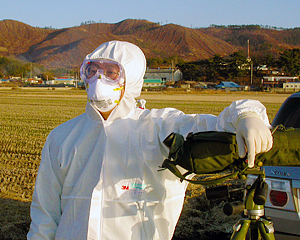
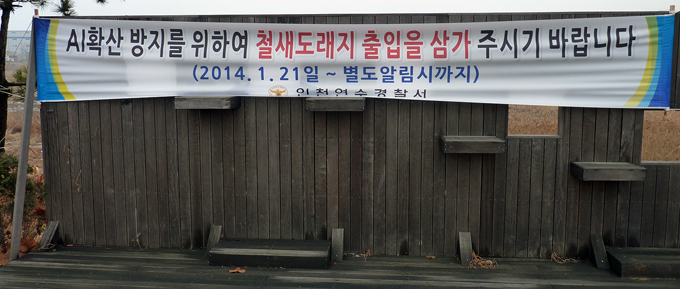
Biodiversity is the web of life. We are part of it and it surrounds us. Degradation and loss of biodiversity has multiple implications for us all. Take the latest outbreaks of High Pathogenic Avian Influenza (HPAI), or “Poultry Flu”. In mid-January, a poultry farm in Jeollabuk Province, only 50km from downtown Gwangju, reported an outbreak of disease that was killing hundreds of domesticated ducks. Within a few days, this Poultry Flu outbreak had spread from the farm to a nearby agricultural reservoir and also to other farms. Although this virus at present poses no danger to people, for over a week TV screens have broadcast sinister-looking images of officials in white biohazard suits, blocking roads and spraying vast quantities of disinfectant into the environment. And we are told without hesitation by national media: “Migratory Ducks (are) To Blame for Outbreak” (Korea Times, January 20th).
What has this to do with loss of biodiversity? Reference to scientific literature confirms that the present strain of this virus (H5N8) has never before been found in wild birds. It also reveals that in order for Low Pathogenic strains of avian influenza to become High Pathogenic (when the disease becomes deadly), the virus usually first needs to pass multiple times through the respiratory tracts of other birds. This can only happen when birds remain in very close proximity to each other, in unnaturally confined conditions. These are not the conditions of natural ecosystems. They are, however, the typical conditions of modern, industrial-scale poultry farms, where many thousands of chickens and ducks are held dreadfully cramped and confined, effectively sealed-off from the outside.
In the wild, most birds are quite fastidious about hygiene. They spend long periods preening to maintain feather condition; adults of most species remove faecal sacks from the nest; and some, like cranes, prefer to roost in running water so that their droppings are washed away. Therefore, while Low Pathogenic influenza strains are common in wild birds (as they are in people) they very rarely develop into High Pathogenic strains.

The nationwide loss of most natural wetland to agriculture and industry means that the majority of Korea’s waterbirds are now forced to use agricultural areas for feeding and roosting. The Baikal Teal, a spectacularly-patterned bird honoured in Birds Korea’s logo, is one such waterbird species. Baikal Teal have no choice but to feed on spilt rice grains left over from the last harvest. This can bring them close to poultry farms and to infected manure or droppings.
There is already abundant evidence that poor biosecurity within the poultry industry has enabled the transfer of “Poultry Flu” both to other farms and to the wider environment. There is, by contrast, no documented case of a Baikal Teal flying in and out through sealed entrances into a poultry farm. Baikal Teal are not infecting poultry. Rather, they are the victims of disease, habitat loss and human actions.
From 2013:
Yet Another Strain of Poultry Flu: H7N9
Specialist Statement on H7N9 Avian Influenza in China: April 15th 2013
H7N9 Update as of April 10, 2013
The novel strain of avian influenza (H7N9) infecting birds and humans in China has been found in over 20 people in four provinces of the country and has caused 8 human deaths so far. So far, the virus does not appear to be highly pathogenic in birds, hence, making it more challenging to monitor and control. It has been found in domestic chickens, domestic ducks, domestic pigeons and domestic quail and has led to the culling of poultry as a precautionary measure. To date, H7N9 has not been found in any wild birds. Currently, it appears that the internal genes of this strain are most similar to AI virus circulating in domestic poultry, and as well, the N9 segment appears most closely related to virus found in domestic poultry. Only the H7 segment appears to be closely related to virus found in wild waterfowl. The continuing emergence of these new strains in this region is concerning and most probably relates to the recent rapid expansion in poultry industry and changing agroecology. Risks to people, livelihoods and biodiversity conservation are significant and need quantifying.
The IUCN SSC Wildlife Health Specialist Group encourages any collaboration to assist in understanding the origins, distribution, and potential spread of this new strain of influenza. Precautions to prevent the accidental spread of this new strain from domestic poultry to wild birds or the environment need to be implemented urgently, and attention to the safety of emerging livestock production systems in relationship to pathogen evolution is needed.
Respectfully,
Billy Karesh and Richard Kock, Co-Chairs
Catherine Machalaba and Lisa Starr, Program Officers
IUCN Wildlife Health Specialist Group
WHSG@EcoHealthAlliance.org
Twitter: @IUCNWildHealth
Facebook: IUCN SSC Wildlife Health Specialist Group
From 2005:
Rather than just assuming that wild birds are behind the spread of H5N1, we urge our members to ask media, decision-makers and other conservation organisations:
In what way does a similar genetic make up in the virus in birds in Poyang and birds at Qinghai constitute evidence that wild birds moved the virus from Poyang to Qinghai? Is it not possible that they could simply have been infected by the same strain of virus at a similar stage of that virus's evolution? That the virus in Turkey is also similar seems more to suggest that the virus was carried mechanically across China, and through to Turkey - as we all understand that there is not a single wild bird species that migrates in the way the virus spread last summer, yet there is plenty of trade that moves across Asia.
Of direct relevance to this: in which conditions would a virus be most likely to evolve/not evolve? In relatively stable conditions when the virus can always find a host (e.g. poultry) or in the various different environments encountered by stressed migrant birds? Why so little evolution of the virus detected between Poyang, Qinghai and Turkey?
No bird species is believed to migrate from Pohang to Qinghai and onto Europe (and now Nigeria), but spread by domino effect in wild birds also seems a rather poor hypothesis. If the domino effect was in place, then why would the spread be so one-directional? Why would outbreaks not have spread back eastward as well? Why no outbreaks in wild birds after Qinghai and Mongolia here in Korea? Or in India? (As an aside, why is this negative data not considered of significance, and included in discussions?).
Why in Poyang was there apparently no outbreak of disease in wild birds, yet at Qinghai there was? It might be the seasonal stresses involved; and/or it might be that birds occupying territories are less likely to move out from such territories once established, thus increasing risk of exposure, and/or it could be that the infection was at a different stage between sites.
It is clear that as the virus was so similar genetically that it was not due to some major evolutionary change in the virus itself.
Some studies have suggested that recovering domesticated mallards shed less virus than when incapacitated by disease. What seems evident is that the responses at Poyang and Qinghai were different (no outbreak in wild birds compared to severe outbreak). This alone at least suggests that the same birds from Poyang, unable to infect birds there, would be unable to infect birds at Qinghai. It seems unlikely that this is simply a matter of resistance: so few birds have been shown to be resistant to HPAI H5N1, and migratory birds are turning over at key wetlands all the time.
Would a reasonable hypothesis rather be that the recovering waterbirds had been exposed to the highly virulent virus some time before (i.e. not at Poyang); that when they arrived there (whether over a short distance or not) they did not shed enough virus to infect other wild birds? At Qingahi, exposure by waterbirds to the same strain of virus from a new local source then created an immediate outbreak in wild birds. Over time, this petered out as birds avoided infected areas, and the virus lost its virulence (in line with our understanding of natural selection). Background research reveals manure-enriched fish-farms at the same lake at Qinghai, a nearby Buddhist temple, and significant concentrations of poultry in local areas: all likely sources of virus?
The genetic evidence suggests shared origin: it does nothing to reveal how wild birds can actually infect poultry. We can easily see how wild birds have become infected though contact with other wild birds (e.g. at Qinghai and in Mongolia); we can see how wild birds have become infected through contact with poultry or contaminated environment (non-migratory bird species in Japan and Korea, perhaps Tree Sparrows in China); but are wild birds somehow supposed to become infected, then fly into chicken coops etc, before flying off again? In some areas, it is clear that there are free range poultry, and some opportunities for infection of poultry by wild birds (and again, vice versa, as with free-range duck rearing at Poyang and elsewhere), but how can a Great Crested Grebe on a lake in Novosibirisk for example be supposed to infect a flock of turkeys kept in a village? And how can this kind of improbable method of infection have happened not once, but tens or even now hundreds of times?
Birds Korea takes a very conservative, well-traveled line on H5N1. We believe that the movement of poultry and caged birds or contaminants from China, especially by road and rail, has led to an explosive near-one-directional movement, from areas with widespread (endemic) H5N1 and asymptomatic poultry into areas with a demand for cheap poultry products and limited control and documentation. We all know (for we have been saying it for years) that wild birds know no borders...So this presence or absence of border controls and strictly-enforced regulations can affect only poultry and caged birds. It is a major reason why the virus has not impacted Western Europe yet, nor several countries in Far East Asia; nor Australasia; nor North America. For such countries have much stricter controls on poultry and caged bird imports. This is why H5N1 is likely to continue to impact developing economies more significantly, countries where resources are more limited and where regulations and controls on movements of animals are less strict (Indonesia, Viet Nam, China, Turkey etc).
In summary, for the sake of the birds and for the sake of people, H5N1 should not be sensationalized or reported irresponsibly.
The spread (and method of spread) of the virus needs to be reported accurately and with balance, and specialists from many fields need to cooperate more efficiently to exchange relevant information openly and freely.
Based only on the best available information, the public and decision-makers then need to develop appropriate responses.
For now, these need to include improved biosecurity (preventing poultry from infecting wild birds and their habitats); improved regulation of trade in poultry and caged birds (especially in the understanding that some species can carry HPAI H5N1 asymptomatically); and greater protection of wild bird populations, in line with national laws or international conventions.
Assessment of virus movement across continents: using northern pintails as a test
Dirk V. Derksen, Alaska Science Center, 4210 University Drive, Anchorage, AK 99508
A CMC Misson report is available as downloadable .pdf document:
Understanding the potential role of wild birds in the epidemiology of the current HPAI outbreaks in the Republic of Korea 13-21 December 2006
On December 7th 2006 Nial Moores, Director of Birds Korea, made a presentation to a symposium on Avian Influenza at the Migratory Birds Observation centre in Gunsan, organized by UNDP-GEF and local bird conservation and citizens groups.
For the text please go to H5N1 Report presented by Nial Moores, Birds Korea
Birds Korea statements:
Birdlife International's position statements:
Other news
Poultry Flu And A Request to Report Specially Marked Waterbirds from Mongolia. Aug 2007
THREE new outbreaks of so-called Avian Influenza in South Korea. 27 Nov 2006
Chinaview: UN: Migratory birds not major cause of flu transmission. 12 Nov 2006
Washington Post: In Vietnam, a Gateway for Bird Flu. 30 Jul 2006
New York Times: Migrating Birds Didn't Carry Flu. 11 May 2006
Herald Tribune: Smugglers undercut fight against bird flu. 14 April 2006
BBC: UK government's chief scientific adviser says, Risk of human flu outbreak 'low'. 09 Apr 2006
The Independent: Factory farms in Asia blamed for pandemic. 08 Apr 2006
"The Lancet" says, Avian influenza goes global, but don't blame the birds. 05 Apr 2006
Report by respected NGO lays blame squarely at the door of the Poultry Industry. 02 Mar 2006
The Economist:Poultry Flu - common sense begins to appear. 23 Feb 2006
BirdLife International's Leon Bunnun on the BBC Website.13 Feb 2006
Moscow Zoo's Chief Vet attributes bird flu spread to illegal poultry trade. 27 Oct 2005
Informed additional (lively!) discussion and opinion at: